Why Two Machines With the Same Name Train Different Muscles
Quick Answer: Machines with the same name vary in back angle, movement path, pivot location and resistance curve, and each of those changes which muscles do most of the work. A 45-degree leg press loads the glutes and hamstrings more than a horizontal one; a converging chest press changes the pectoral emphasis; a lat pulldown with a different pivot changes how much the lats contribute versus the arms. This is why a weight that felt easy at one gym feels impossible at another, and it is not a sign that anything has gone wrong with you.
You moved gyms and lost 30kg on the leg press overnight.
You did not get weaker. You are doing a different exercise with the same name.

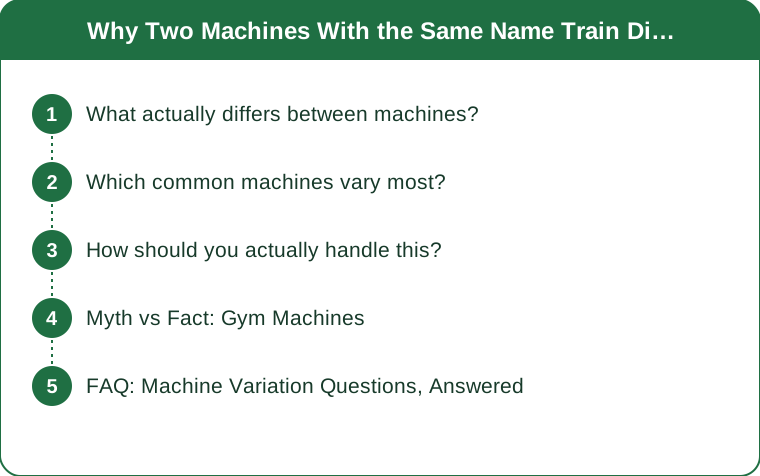
What actually differs between machines?
Four variables, each of which changes the outcome substantially.
Body angle relative to gravity. A 45-degree leg press has you reclined with the weight travelling on a diagonal. A horizontal or seated leg press pushes forward. The hip angle at the bottom of the movement is completely different, which changes how much the glutes and hamstrings contribute versus the quadriceps.
Movement path. Some machines move on a fixed linear track; others swing on an arc. Converging machines bring the handles toward each other as you press, which increases the range of shoulder horizontal adduction and changes the pectoral involvement. Diverging designs do the opposite.
Pivot point location. On any rotary machine - leg extension, leg curl, lateral raise - the pivot should align with the joint it is training. If the machine’s pivot sits a few centimetres from your knee’s axis of rotation, the resistance profile changes and so does where the load is felt.
Resistance curve. This is the least visible and one of the most important. Cam-based machines use a shaped pulley to vary resistance through the range - heavier where you are strong, lighter where you are weak. Different manufacturers shape cams differently, so two machines can feel hardest at completely different points.
Beyond those four, smaller factors add up:
- Weight stack calibration, which is often approximate rather than exact
- Leverage in plate-loaded machines, where 20kg of plates may deliver 12 or 30kg at the handles depending on the arm ratio
- Friction and maintenance, which can add meaningful resistance on a poorly serviced machine
- Seat and pad positions, which change your leverage before you have moved anything
Which is why comparing numbers between machines is close to meaningless, and why a training log that records the gym and the specific machine is far more useful than one that records only the weight.
Which common machines vary most?
The leg press, the chest press and the lat pulldown - by a wide margin.
Leg press. The largest variation of any common machine.
- 45-degree sled: you sit reclined, the platform moves diagonally. Allows the heaviest loads and involves more glute and hamstring through the greater hip flexion at the bottom
- Horizontal or seated: you sit upright and press forward. More quadriceps-dominant, lower absolute loads, easier on the lower back
- Cable or selectorised versions: generally lighter still, with a different resistance curve entirely
Expect a difference of 30 to 50% in usable load between a 45-degree sled and a horizontal press. This is normal and says nothing about your strength.
Chest press.
- Converging: handles move toward each other. More pectoral involvement at the end range, and generally feels more natural
- Parallel or fixed path: handles travel straight. More triceps and front deltoid contribution
- Back angle varies from flat to noticeably inclined, which shifts emphasis toward the upper chest
Lat pulldown.
- Cable-and-pulley versions allow the bar path to vary with your body position, so technique changes the muscle emphasis considerably
- Lever-based versions fix the path, which is more consistent and gives you less scope to adjust
- The pad height and thigh restraint change how much you can lean back, which changes the exercise substantially
Shoulder press, leg extension and leg curl vary less in which muscle they train and considerably in resistance curve, so the weight moves but the target does not.
Plate-loaded machines deserve a specific warning. The load at the handles depends on the lever arm ratio, which is invisible. Two plate-loaded rows from different manufacturers, both with 60kg loaded, can deliver quite different resistance. Never compare plate-loaded numbers across brands.

How should you actually handle this?
Log the machine, re-establish your working weight, and judge by effort rather than by number.
When you use an unfamiliar machine:
- Start at roughly 60% of what you would normally use for that exercise
- Do a set of 10 and assess - it should feel clearly easy
- Add 20% and repeat
- Find your working weight in two or three sets rather than trying to jump straight to it
- Write down the machine, not just the weight - the brand and the location
Set-up matters more on an unfamiliar machine than on a familiar one:
- Align the pivot with your joint. On a leg extension, the machine’s rotation point should sit level with the outside of your knee. On a lateral raise, level with the shoulder
- Adjust the seat before loading it, not after
- Check your range at the light weight - if you cannot reach full range, the setup is wrong
- Note the settings, since seat position numbers are the fastest way to reproduce a good setup next time
How to judge whether it is working, independent of the number:
- Where do you feel it? If a chest press feels entirely in the front shoulder, the setup or the machine geometry does not suit you
- Is the last rep hard? This is the only measure that transfers between machines
- Can you complete full range under control? If the machine forces a shortened or awkward path, use a different one
And the strategic point: for tracking progress, use the same machine consistently. Progressive overload is measured within a machine, not across machines. If you train at two gyms, keep two separate logs - the numbers are not comparable and trying to reconcile them produces false conclusions about your progress.
If a machine simply does not fit you - and this is common for anyone significantly taller or shorter than average - substitute a different exercise rather than forcing it. A machine you cannot align with your joints is training something other than what it says on the label.
Myth vs Fact: Gym Machines
Myth: A leg press is a leg press. Fact: A 45-degree sled and a horizontal press differ by 30 to 50% in usable load and load the glutes and hamstrings differently, because the hip angle at the bottom is not the same. They are related exercises with the same name.
Myth: The number on the stack is the resistance. Fact: Stack markings are often approximate, and on plate-loaded machines the lever arm ratio changes the load at the handles substantially. Sixty kilograms loaded does not mean sixty kilograms felt, and the ratio differs by manufacturer.
Myth: If you dropped weight after switching gyms, you lost strength. Fact: Different geometry, different resistance curve, different leverage. Strength does not disappear over a weekend. Re-establish a working weight on the new machine and track from there.
Myth: Machines are all beginner-safe regardless of setup. Fact: A pivot misaligned with your joint changes the load path and can put strain where it does not belong. Setting the seat correctly is more important on a machine than on most free weight exercises, not less.
Myth: The cam makes the resistance constant. Fact: The cam varies resistance deliberately to match your strength curve, and manufacturers shape them differently. Two machines can feel hardest at completely different points in the same movement.
Myth: If it feels easier, it is a worse machine. Fact: It may simply have better leverage or a different resistance curve. The measure of a machine is whether you can align it to your joints, reach full range, and make the last rep hard - not what number is on the stack.
FAQ: Machine Variation Questions, Answered
Why can I press so much more on one leg press than another?
Back angle and movement direction. A 45-degree sled has you reclined with the platform moving diagonally, which allows more load and involves more glute and hamstring. A horizontal press is more quadriceps-dominant at lower absolute loads. A 30 to 50% difference is normal.
Are the numbers on the weight stack accurate?
Approximately. Stack markings are frequently rounded, and machines vary in friction and maintenance. On plate-loaded machines the lever arm ratio means the load at the handles differs substantially from the plates loaded, and that ratio varies by manufacturer.
How do I set up an unfamiliar machine?
Align the machine’s pivot with the joint it trains - level with the outside of the knee on a leg extension, level with the shoulder on a lateral raise. Adjust the seat before loading, check full range at a light weight, and note the seat position number for next time.
Should I keep separate logs for two gyms?
Yes. Progressive overload is measured within a machine, not across machines, and trying to reconcile numbers between different equipment produces false conclusions in both directions. Two logs is the simpler and more accurate approach.
What if a machine does not fit me?
Substitute a different exercise rather than forcing it. If you cannot align the pivot with your joint or reach full range, the machine is training something other than what it is labelled as, and there is always an alternative.
How do I know if a machine is working for me?
Three checks: you feel it in the intended muscle rather than only in the joints or the smaller assisting muscles, you can complete full range under control, and the last rep of the set is genuinely hard. All three transfer between machines; the number does not.
TL;DR:
- Back angle, movement path, pivot location and resistance curve all differ between same-named machines
- Leg press varies most - expect 30 to 50% difference in load between a 45-degree sled and a horizontal press
- Converging chest presses load the pectorals differently from fixed-path ones
- Plate-loaded machines hide their lever ratio, so plates loaded is not resistance felt
- Align the machine pivot with your joint, adjust the seat before loading, and note the settings
- Start at 60% on an unfamiliar machine and build up over two or three sets
- Keep separate logs per gym - numbers do not transfer, effort does
You did not lose 30kg overnight. You changed exercises without changing the name.
Keep Reading
This article is for general informational and styling purposes only. Fit, sizing, and product availability may vary.