Why 20kg on the Cable Stack Isn't 20kg in Your Hand
Quick Answer: Most cable machines use a pulley ratio — commonly 2:1 on a single-column stack — so the weight you feel can be half the stack you selected, or occasionally more. Add unlabelled or mislabelled plates, cable friction, and the machine’s own moving parts, and cable numbers are only meaningful relative to the same machine. Never compare them to dumbbells or across gyms.
You do 20 on the cable row. You do 20 with a dumbbell. They feel nothing alike.
Then you go to a different gym, set the same number, and it is a different exercise entirely.
Nobody is lying to you. Cable stacks measure something genuinely different from what the number on the plate implies, and once you know why, the whole category of confusion goes away.

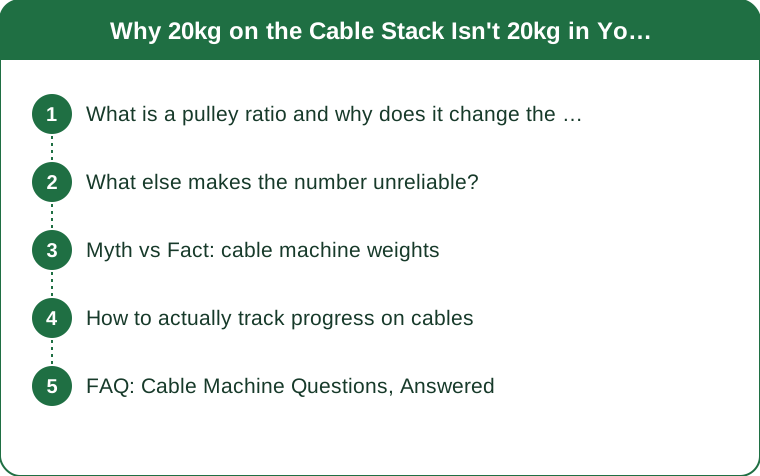
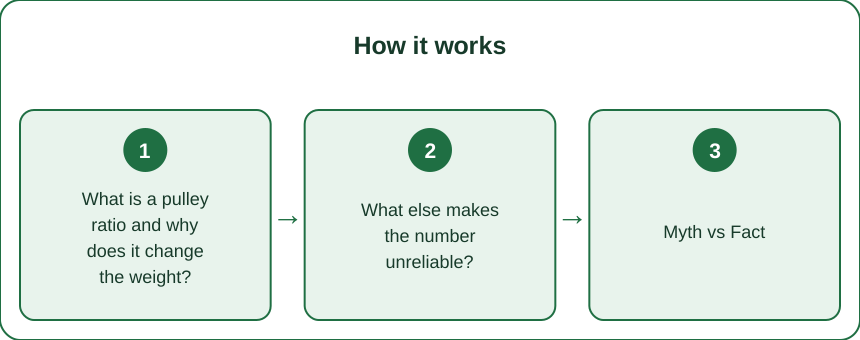
What is a pulley ratio and why does it change the weight?
A pulley system trades distance for force, and cable machines use that deliberately.
In a simple 2:1 arrangement, the cable attached to the weight stack is routed through a movable pulley, so pulling one metre of cable raises the stack only half a metre — and the force you feel is roughly half the stack weight. That is why single-column cable towers so often feel light relative to the number, and why the handle travels a long way.
Different machines use different arrangements. A lat pulldown is frequently close to 1:1, so 40 selected feels close to 40. Many functional trainers and dual-adjustable pulleys run 2:1, so 40 selected feels like about 20. Some plate-loaded machines with lever arms change the effective resistance across the range in a way that has no single number at all.
The practical rule that comes out of this: the number on a cable stack is a setting, not a measurement. It is a reliable, repeatable setting on that machine, which is all you actually need for progressive overload.
Manufacturers usually publish the ratio, and some machines have it printed near the stack. It is worth looking once at the machines you use most, purely to stop the mental arithmetic.
What else makes the number unreliable?
Four things, in rough order of size.
Friction in the cable path. Every pulley, every direction change and every worn bushing eats force. Well-maintained machines lose relatively little; neglected ones can feel noticeably heavier on the way up and lighter on the way down. If a machine feels sticky, that is friction and it is not consistent through the range.
The weight of the moving parts themselves. Carriages, handles, cable and the top plate all have mass. On light settings this is a meaningful fraction — the difference between the lightest setting and nothing at all can be several kilos.
Plate labelling. Stack plates are sometimes labelled in cumulative kilos, sometimes in pounds, occasionally in arbitrary numbers with no unit at all. A stack marked 1 through 20 is telling you an order, not a weight.
Line of pull and body position. The same 20 at a low pulley versus a high pulley versus horizontal produces completely different demands, because the direction of resistance relative to the joint changes. This is a feature of cables, not a flaw, but it does mean the same number is a different exercise at a different height.
Together, these are why two identical-looking machines from different brands can differ by 30 percent at the same setting.

Myth vs Fact: cable machine weights
Myth: gyms set cable stacks light to flatter members. Fact: it is a mechanical consequence of the pulley arrangement, not marketing. The machine is doing exactly what its design says.
Myth: cables are easier than free weights. Fact: cables provide more constant tension through the range and less help from momentum, which makes some movements harder at the same effective load. Ask anyone who has done cable lateral raises at what they thought was a light weight.
Myth: you can convert cable numbers to dumbbell numbers. Fact: not usefully. Even with the ratio known, line of pull, tension curve and stabiliser demand differ. Track cables against cables.
Myth: the pin-loaded number is precise. Fact: it is precise as a setting and approximate as a weight. Both facts are fine simultaneously.
Myth: a heavier cable number means a better workout. Fact: the number is machine-specific. What matters is whether it went up on that machine, and whether the reps were controlled.
How to actually track progress on cables
Record the machine, not just the number. Write down cable row, station 3, setting 12. When you change gyms or the gym rearranges, you will know why the number moved.
Progress within a machine only. Went from 12 to 14 on the same station with the same attachment and the same reps? That is progress, and it is real regardless of what 14 weighs.
Note the attachment and the pulley height. A rope, a straight bar and a single handle at the same setting are three different exercises. So is the same handle at hip height versus shoulder height.
Use reps and control as the primary variable when the increments are large. Some stacks jump in 5-kilo increments, which at a 2:1 ratio is a 2.5-kilo change in felt load — but on light isolation work that can still be a 20 percent jump. Add reps first, then the plate, rather than forcing an increment your tissue is not ready for.
Use add-on magnets or a small plate on the top of the stack if your gym has them, for exactly that reason.
Do not chase the cable number to match your dumbbell number. That is the single most common way people end up using momentum and losing the specific advantage cables offer, which is constant tension with a controlled path.
FAQ: Cable Machine Questions, Answered
How do I find out my machine’s ratio?
Look for a plate or sticker near the stack, check the manufacturer’s spec online, or run a rough test: hang a known dumbbell weight on the cable and see which setting just lifts the stack. The test is quick and it settles the question permanently for that machine.
Should I be worried that I lift much less on cables?
No. Different tension profile, different stabiliser demand, and often a pulley ratio in play. Comparing across modalities tells you nothing useful about strength.
Why does the same setting feel harder some days?
Same reasons as any exercise — sleep, prior training, position, and whether you warmed up. Add one cable-specific factor: a slightly different starting position or stance changes the leverage, and on cables that is easy to do without noticing.
TL;DR:
- Cable stacks often run a 2:1 pulley ratio — 20 selected can mean about 10 felt.
- Friction, moving-part mass and inconsistent plate labelling add more slack to the number.
- Cable numbers are settings, not measurements — reliable on one machine, meaningless across machines.
- Record machine, station, attachment and pulley height alongside the number.
- Add reps before plates when the stack increments are coarse.
Find the ratio on the two cable machines you use most — it takes five minutes and permanently removes the nagging sense that one of your numbers must be wrong.
Keep Reading
This article is for general informational and styling purposes only. Fit, sizing, and product availability may vary.