Why the Seat Height That Felt Right Last Week Feels Wrong Today
Quick Answer: Machine settings interact with your body on the day — footwear stack height, warm-up state, hip and ankle mobility, and even which machine of a pair you are using all shift the effective position. A recorded number is a starting point to check against, not a setting to trust blindly.
You are organised. You have the numbers in your notes app: chest press seat 4, leg press back 3, lat pulldown thigh pad 6.
Today seat 4 puts the handles somewhere unhelpful and the whole set feels wrong from the first rep. Here is what changed while the number stayed the same.

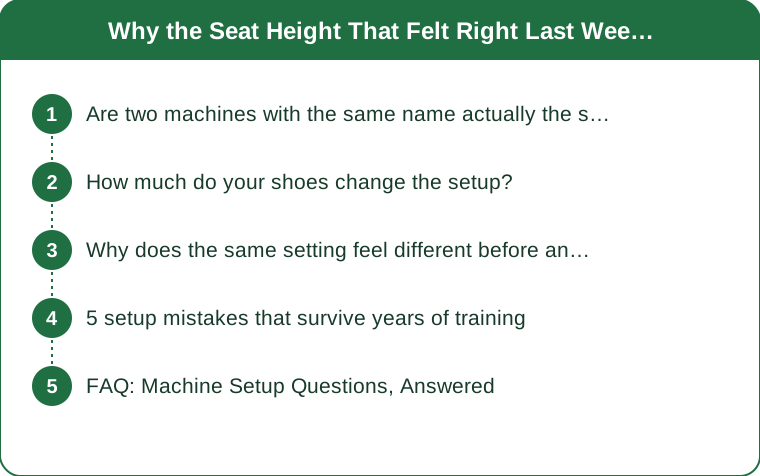
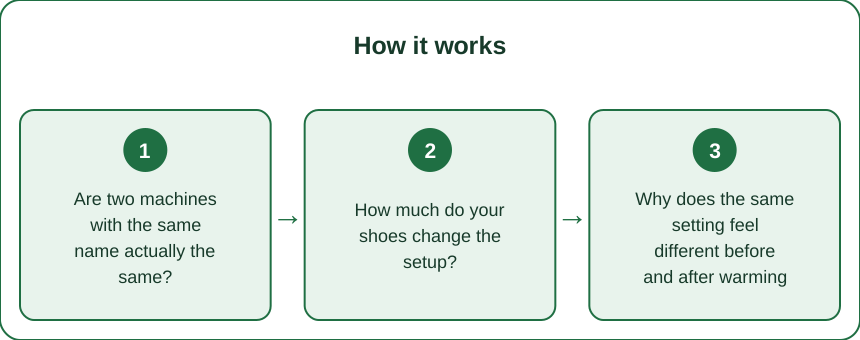
Are two machines with the same name actually the same?
Very often, no — and this is the explanation people find hardest to believe until they check.
Manufacturers number seat positions differently, and even within one brand, two production runs of the same model can have different pin spacing. A gym that has bought equipment over several years frequently has two chest presses that look nearly identical and index completely differently. Position 4 on one can sit between positions 3 and 4 on the other.
Beyond numbering, the mechanics differ. Cam-based machines vary the resistance curve through the range of motion, and two cams designed for the same exercise can load the movement very differently. Lever length, handle angle, and the pivot point relative to the seat all change where your joint needs to be for the movement to track correctly.
The practical consequence: your number is machine-specific, not exercise-specific. If your gym has two of everything, note which one. It sounds fussy. It removes an entire recurring source of confusion.
A quick diagnostic — if the setting feels wrong from the very first rep rather than becoming wrong mid-set, you are usually on a different unit than you think.
How much do your shoes change the setup?
Enough to matter on anything where your feet contact a platform or the floor.
Stack heights vary widely: a flat-soled lifting shoe or a plimsoll might put 8 to 12 mm between your heel and the ground, a standard trainer 20 to 25 mm, and a max-cushion running shoe 35 to 40 mm. That is up to three centimetres of difference in effective seat height, and it lands entirely on the exercises where it matters most — leg press, seated leg curl, calf raise, anything with a foot plate.
Cushioning adds a second, subtler problem. Soft foam compresses under load and rebounds, so your position shifts within each rep. On a heavy leg press this shows up as a vague, unstable feeling at the bottom of the movement that people usually attribute to the machine.
There is also the heel-to-toe drop. A shoe with a 10 mm drop puts your ankle in slight plantarflexion before you start, which changes the effective hip and knee angles at the same seat setting.
Simple rule: if you change shoes, re-check your leg machine settings once. Note both the setting and the shoe. Most people who train in one pair never encounter this, then get baffled the first week after buying new trainers.
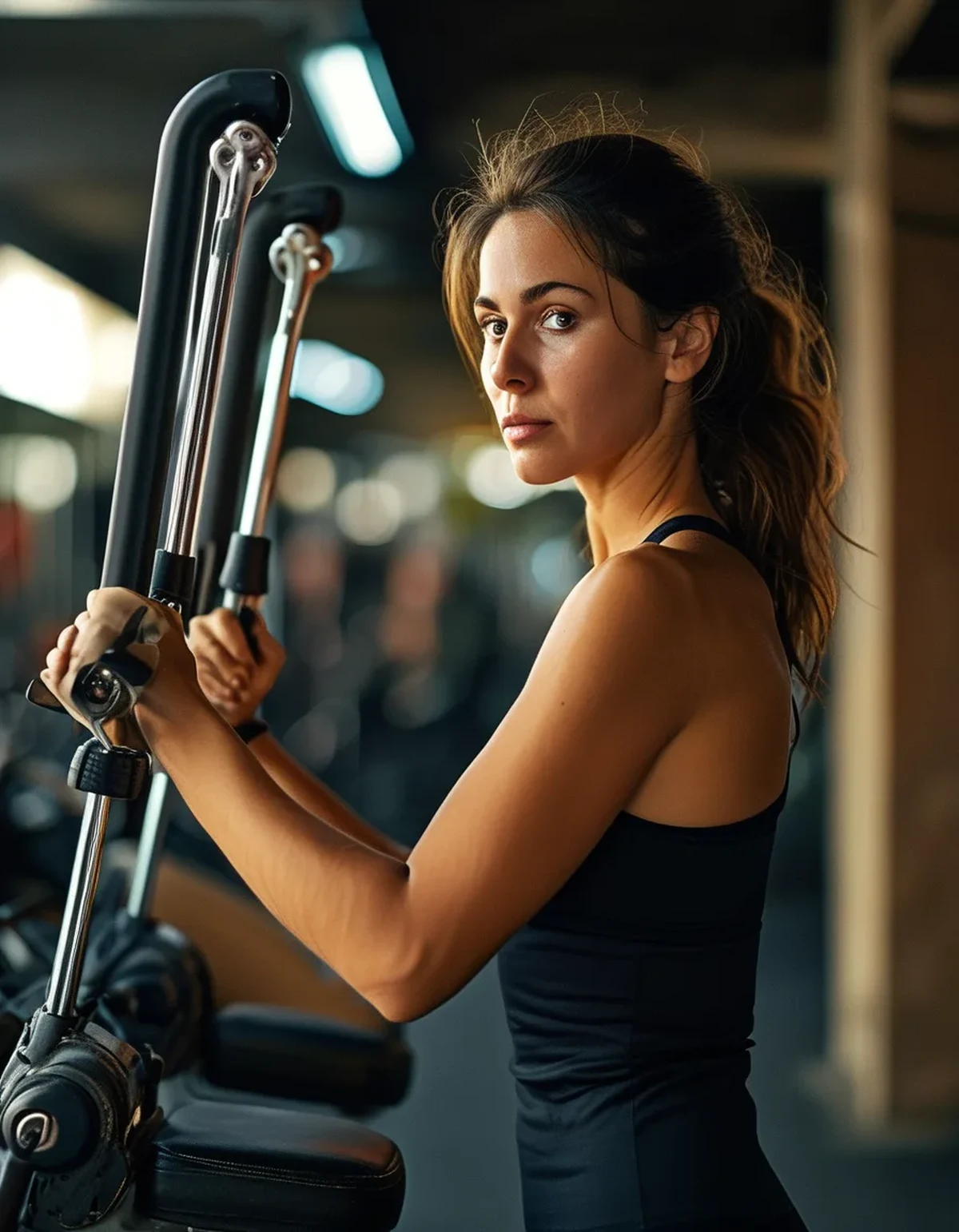
Why does the same setting feel different before and after warming up?
Because the position you can comfortably occupy depends on your available range of motion, and range of motion is not a constant.
Joint range changes measurably with tissue temperature. After a proper warm-up, hip flexion, ankle dorsiflexion, and shoulder external rotation all improve — typically by a few degrees, sometimes considerably more in people who sit for long periods. A seat setting that lets you reach full depth at the end of a session can be unreachable in your first set of the day.
Time of day compounds it. Spinal discs are more hydrated in the morning, which increases sitting height by up to a centimetre or two and slightly reduces trunk flexibility. So the same seat can feel low in the morning and fine at night.
Then there is prior training. Trained calves are stiffer; trained lats reduce overhead reach; a heavy hinge session two days ago changes how your hips sit against a back pad today.
The takeaway is not that recording settings is pointless — it is that the number should be checked against a position cue, not substituted for one. Know what the right position looks like: joint stacked over pivot, full range achievable without shifting off the pad, contact points maintained throughout. Then use the number to get close quickly.
5 setup mistakes that survive years of training
1. Setting the seat so the weight feels heaviest. People unconsciously choose positions that give the strongest sensation in the target muscle, which is often a shortened range with poor joint stacking. Sensation is not a setup criterion.
2. Never adjusting the back pad. On chest press and row machines, the back pad position changes the handle path relative to your shoulder far more than seat height does. Most people adjust one and ignore the other.
3. Matching the setting to the previous user. The seat is already at 5, you use 5, you never notice that your actual number was 3. This accounts for a large share of “it feels wrong today”.
4. Sitting too far forward on the seat. On any machine with a back pad, sliding forward by a few centimetres unloads the pad, removes your stable base, and changes every angle at once. Sit back until you contact the pad, every set.
5. Not re-checking after a layoff. Two weeks off changes mobility and often body composition. The fourth mistake catches almost everyone: they return from holiday, use their old numbers, and conclude they have lost strength when they have really lost position.
FAQ: Machine Setup Questions, Answered
How do I know if the seat height is correct rather than just comfortable?
Check joint alignment against the machine’s pivot. On a chest press, handles should sit roughly at mid-chest with elbows able to travel just past your torso. On a leg extension, the knee joint should line up with the pivot bolt. Comfort is a poor proxy — a slightly wrong setting is often the more comfortable one because it shortens the range.
Is it worth recording settings at all if they change?
Yes. Recording gets you to approximately right in ten seconds instead of trial-and-error across your first working set. Treat it as a bookmark, then confirm with a position check on the first rep.
Should I always use the same machine for the same exercise?
Where you can, yes — it makes progression easier to read because the resistance curve stays constant. When your usual machine is taken, expect the numbers to differ and adjust the load rather than forcing the same weight on a differently geared unit.
TL;DR:
- Two machines with the same name often index differently — record which unit, not just the number.
- Shoe stack height can shift effective seat height by up to 3 cm on leg machines.
- Range of motion changes with warm-up state, time of day, and recent training, so a setting is a starting point.
- Check position against joint-and-pivot alignment on the first rep, every time.
The number in your notes is genuinely useful. It just answers the question of where to start, not the question of whether you are set up correctly — and those get confused constantly.
Keep Reading
This article is for general informational and styling purposes only. Fit, sizing, and product availability may vary.