Why the Machine You Always Use Is Suddenly Always Taken
Quick Answer: Congestion concentrates on a small number of machines - typically leg press, lat pulldown, cable stations, and the main cardio row - because those are the ones new gym-goers are pointed toward and the ones with the widest range of uses. The fix is a substitution list written before you arrive, so that finding your machine occupied is a two-second decision rather than a stressful one. Free weights and bodyweight alternatives cover almost every machine exercise.
It is the second week of September and the leg press has a queue. Not the squat rack, not the dumbbells - the leg press specifically. This is not random, and once you see the pattern you can train around it entirely.

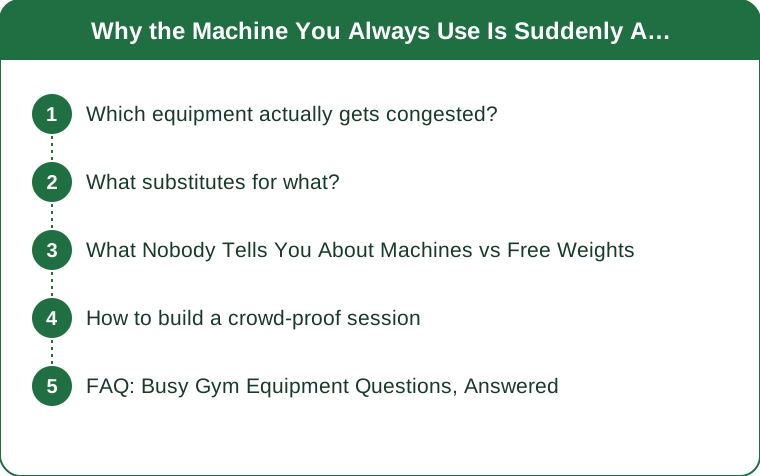
Which equipment actually gets congested?
A predictable subset, for predictable reasons.
Machines with an obvious purpose and a seat. New gym-goers gravitate toward equipment with a diagram on it and a clear starting position, because it removes the uncertainty that makes a gym intimidating. Leg press, chest press, lat pulldown, and seated row are the classic cluster.
Cable stations, because they do everything. A single cable tower serves a dozen exercises, which means a dozen people want it. It also means people spend a long time at one, cycling through several movements.
The main cardio bank at peak hours, particularly treadmills, as darker evenings push runners indoors. This is the most seasonal of all the congestion patterns.
Benches, especially flat ones. They are needed by anyone doing dumbbell work as well as anyone pressing, which makes them one of the highest-demand items in most gyms.
What generally stays available: the squat rack in many gyms, dumbbells above a certain weight, kettlebells, floor and stretching space, and older or less obvious machines. The pattern is consistent enough to plan around.
Why this matters: if your programme depends entirely on the congested cluster, autumn will be frustrating. If it can run on dumbbells, a bench, and floor space, you will barely notice the crowd.
What substitutes for what?
A practical list. Each of these trains the same pattern with different equipment.
Leg press → goblet squat, split squat, dumbbell Romanian deadlift, step-up. The leg press is a knee-dominant press; any loaded squat pattern covers it, and split squats add the single-leg element the machine removes.
Lat pulldown → dumbbell row, resistance band pulldown, chin-up or assisted chin-up, straight-arm pullover. Pulldowns and rows train overlapping but not identical patterns; if the pulldown is busy, a row is the closest available substitute.
Seated row → single-arm dumbbell row, chest-supported dumbbell row, inverted row using a bar or rings. The inverted row in particular is available in almost every gym and consistently underused.
Chest press machine → dumbbell bench press, floor press, push-up variations. Push-ups scale further than people assume - elevate the feet, slow the tempo, add a pause.
Leg curl → dumbbell or barbell Romanian deadlift, hamstring slider curl, single-leg hip hinge. Sliders on a smooth floor replicate the curl pattern surprisingly well with no equipment.
Leg extension → step-up with a slow lowering phase, split squat with an upright torso, wall sit.
Cable station → resistance bands, which cover an enormous share of cable exercises at a fraction of the space and can live in your bag.
Treadmill → rower, bike, stair machine, or simply going outside with the right clothing. Outdoor running in autumn requires a jacket and a head torch and removes the busiest constraint in the building.
The general principle: machines fix the movement path, free weights do not. Substituting a free-weight version usually adds a stability demand, which is a training benefit rather than a compromise.
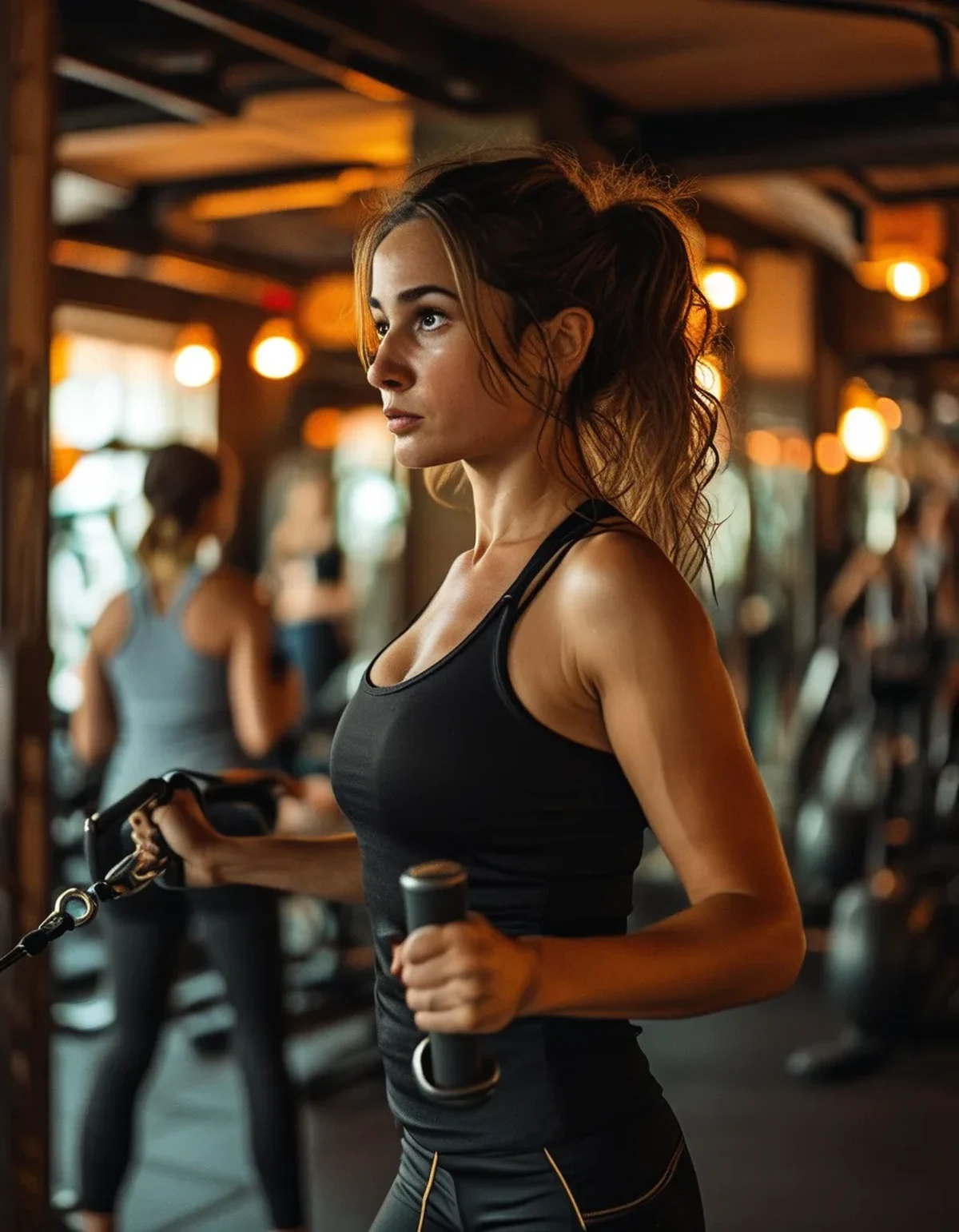
What Nobody Tells You About Machines vs Free Weights
Machines are not a lesser option, and the snobbery about them is misplaced. They allow you to load a muscle safely without a stability limitation, they are easier to learn, and for training a muscle close to failure they are frequently better than the free-weight equivalent because failure is safe.
But they hide asymmetries. A bilateral machine lets the stronger side contribute more, invisibly. Free-weight and single-limb work exposes that, which is one genuine advantage of being forced onto the alternatives.
The strength you build on a machine does transfer, though less completely than like-for-like training. If your goal is general strength and muscle, machines are perfectly effective; if your goal is a specific free-weight lift, you need to do the lift.
Stability is trainable and it is part of the point. Substituting a dumbbell version of a machine exercise means you will use less weight, and that is not a step backwards - the load is limited by a different factor and both factors are worth training.
Machine settings matter more than people realise. Seat height and pad position change which muscles the machine loads and how the joints are aligned, and using a machine on someone else’s settings is a common cause of it feeling wrong. It takes fifteen seconds to adjust.
And you can absolutely build a complete programme without machines. A bench, a set of dumbbells, and floor space cover every fundamental movement pattern. This is worth knowing not as an argument against machines but as insurance against a crowded room.
One thing that is genuinely worth waiting for: if a specific machine is the safest way for you to train a specific movement - because of an injury history, a mobility limitation, or a load requirement - wait for it or reorder your session, rather than substituting into something that does not suit you.
How to build a crowd-proof session
Structure rather than equipment.
Write the substitution next to each exercise before you arrive. This is the whole technique. Leg press, or goblet squat. Lat pulldown, or dumbbell row. Deciding in advance means finding something occupied costs two seconds rather than derailing the session.
Order the session by equipment scarcity, not by muscle group. Do the exercise requiring the hardest-to-get equipment first, while you have time and energy to wait if you must.
Build around a station, not around the room. Claiming a bench with a pair of dumbbells lets you run four or five exercises without moving, which is both efficient and considerate in a busy gym.
Use supersets deliberately. Pairing two exercises that use equipment you already have reduces total time and means you occupy less equipment overall.
Have a bodyweight finisher ready. If the last thing on your plan is unavailable, a planned bodyweight alternative means the session ends on your terms rather than trailing off.
Keep a band in your bag. It substitutes for a cable station, works for warm-ups and for accessory work, and takes no space. It is the highest-value item for training in a crowded gym.
And judge the session by whether you trained the pattern, not whether you used the machine. A session where you squatted instead of leg pressing trained your legs. Treating it as a failed session because the plan changed is what makes busy periods feel discouraging.
One etiquette note, since it comes up constantly: working in is normal and expected on most equipment. Ask how many sets someone has left, ask to work in between them, and offer the same when asked. It is the mechanism the room is designed around.
FAQ: Busy Gym Equipment Questions, Answered
Why are the same machines always busy?
Congestion concentrates on equipment with an obvious purpose and a seat - leg press, chest press, lat pulldown, seated row - because that is what newer gym-goers are pointed toward. Cable stations and benches queue because they serve many exercises. Squat racks, heavier dumbbells, kettlebells, and floor space usually stay available.
What can I do instead of the leg press?
Goblet squats, split squats, step-ups, or dumbbell Romanian deadlifts all train the same pattern, and the single-leg options add a stability element the machine removes. You will use less absolute load, which reflects a different limiting factor rather than a worse exercise.
Are free weights better than machines?
Neither is better in general. Machines allow safe training close to failure and are easier to learn; free weights add a stability demand and expose side-to-side differences that machines hide. A complete programme can be built from either, and using both covers more ground than committing to one.
How do I ask to work in on a machine?
Ask how many sets they have left, then ask if you can work in. It is completely standard gym practice and most people agree immediately. Adjusting the seat or the weight between sets is expected and not considered an imposition.
How do I plan a workout for a busy gym?
Write a substitution beside every exercise before you arrive, order the session so the scarcest equipment comes first, and build around one station where possible - a bench and a pair of dumbbells can carry an entire session. A resistance band in your bag covers most cable work.
TL;DR:
- Congestion is predictable: seated machines with diagrams, cable stations, benches, and treadmills.
- Squat racks, heavier dumbbells, kettlebells, and floor space usually stay open.
- Write a substitution beside every exercise before you arrive - that is the whole technique.
- Order the session by equipment scarcity and build around one station.
- A resistance band in your bag replaces most of what a cable tower does.
You trained your legs. Which piece of metal you used to do it is not what the session was measured on.
Keep Reading
This article is for general informational and styling purposes only. Fit, sizing, and product availability may vary.