Why the Machine That Felt Perfect in Summer Feels Wrong in Autumn
Quick Answer: Three things stack up. Colder mornings mean less joint range available in early sets, September crowding means other people are constantly changing settings you had dialed in, and a summer of different training - or none - has shifted your mobility. The fix is to write your settings down, warm up long enough to actually reach your range, and re-baseline rather than assuming the machine changed.
It is a strangely specific frustration. The same machine, the same weight, and it feels off in a way that is hard to name - the range feels short, or the seat feels wrong, or you cannot find the muscle you used to feel.


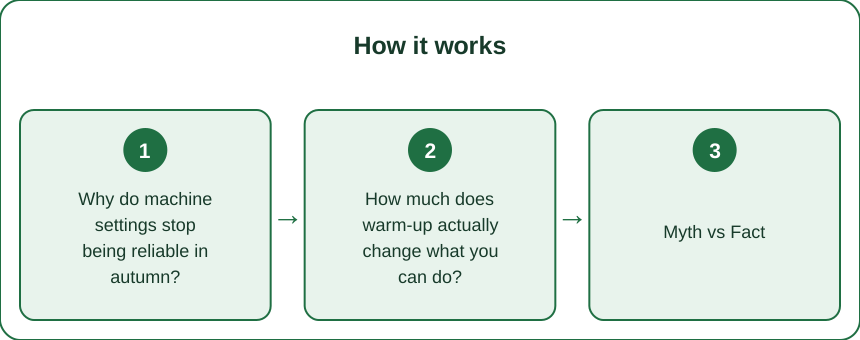
Why do machine settings stop being reliable in autumn?
Because you are not the only person using them, and September brings 20 to 40 percent more people. Seat pins, back pads, and lever arms get moved constantly. Most people set up by feel rather than by number and never notice they are training a slightly different exercise week to week.
Small setting changes are large exercise changes. One notch on a chest press seat changes the pressing angle enough to shift emphasis between the sternal and clavicular fibers. One notch on a lat pulldown thigh pad changes how much you can brace. These are not minor adjustments; they redefine the movement.
Cold joints have less available range early in a session. Synovial fluid is more viscous at lower temperatures, and connective tissue is stiffer. Your first set in a cold gym genuinely has less range than your third, and a setting calibrated to your warm range will feel wrong cold.
And your body has changed over the summer. If you spent June to August cycling, running, or doing very little, your hip and shoulder mobility is different from what it was in May. The machine is the same; the person is not.
Write your settings down. Seat 4, back pad 2, lever 3. Ten seconds in your phone, and every future session starts from a known position rather than from a guess.
How much does warm-up actually change what you can do?
Muscle temperature is one of the largest single variables in performance. Warm muscle contracts faster, produces more force, and moves through more range. A properly warmed muscle can produce measurably more force than a cold one, and the effect is larger in the first sets than most people expect.
Connective tissue needs more time than muscle. Muscle warms in a few minutes; tendons and fascia take longer and are what limit end range. This is why a five-minute bike warm-up gets you feeling ready while your actual range is still restricted.
Cold gyms in autumn make this worse, and gyms genuinely run cooler. Many facilities lower the thermostat in autumn while attendance rises, and the first twenty minutes of a session in a 62F room is a different proposition from the same twenty minutes in July.
The practical version: 10 minutes, not 5, and include the specific joint. General cardio raises core temperature; specific ramp-up sets prepare the exact tissue and range you are about to load. Two light sets on the machine itself beat five extra minutes on a bike.
And do not adjust the machine to fit a cold body. The setting that feels right in set one will feel too short in set four. Set the machine for your warm range and let the first sets be slightly conservative.

Myth vs Fact: machines and setup
Myth: Machines are self-correcting so setup does not matter much. Fact: machines fix the movement path, which means a bad setup cannot be compensated for by adjusting your technique. On a free weight you can adjust; on a machine you are locked into whatever the setting decided. Setup matters more on machines, not less.
Myth: If it feels smooth, it is set correctly. Fact: a machine set too low or too high often feels perfectly smooth while loading the wrong joint angle. Smoothness reflects the machine’s engineering, not your alignment with it.
Myth: Taller people should always use higher settings. Fact: settings track limb length and torso length, not height, and these vary independently. Two people the same height frequently need settings two notches apart. Find yours empirically and record it.
Myth: The weight stack numbers mean the same thing across machines. Fact: they do not, even within one brand. Different lever ratios and cam profiles mean 100 on one machine can be substantially more or less resistance than 100 on another. Compare a machine only to itself.
Myth: If you cannot feel the target muscle, the machine is bad. Fact: sensation is a learned skill and depends heavily on setup, tempo, and load. Fix the setting, slow the eccentric to three seconds, and drop the weight 20 percent before concluding the machine does not work for you.
FAQ: Gym Machine Questions, Answered
How do I find my correct setting on an unfamiliar machine?
Sit in it with no weight and move through the full range slowly. The joint you are training should be aligned with the machine’s pivot point - the axis it rotates around - and you should be able to reach full range without your body shifting position. Adjust until both are true, then note the number.
Should I use machines or free weights in a crowded autumn gym?
Machines are generally the better crowd strategy because they are quicker to set up and less often contested than racks and benches. Use the crowded weeks for machine-based work and return to barbell priorities once the gym thins in November - that is a rational seasonal plan rather than a compromise.
Why does the same machine feel heavier on some days?
Sleep, nutrition, hydration, prior training, and time of day all affect force production, and most people are meaningfully stronger later in the day than early morning. Day-to-day variation of 10 percent is entirely normal. Judge progress across weeks, not sessions.
TL;DR:
- September crowding means your settings get changed constantly - write them down and reset every time.
- One notch on a seat or pad is a genuinely different exercise, not a minor adjustment.
- Cold joints have less range early; warm up 10 minutes and set the machine for your warm range.
- Weight stack numbers are not comparable between machines - only compare a machine to itself.
- Align your joint with the machine’s pivot point; that single check fixes most setup problems.
Keep Reading
This article is for general informational and styling purposes only. Fit, sizing, and product availability may vary.