Why Single-Arm and Single-Leg Machine Work Is Worth More Than You Think
Quick Answer: Working one limb at a time on machines does three things two-sided work cannot: it exposes side-to-side differences that bilateral training hides, it removes the stronger side’s compensation, and it produces more total force per limb through a well-documented effect where each limb generates more force alone than it does as half of a pair. Practically: use single-limb versions of leg press, leg curl, chest press, rows, and every cable movement, start with your weaker side, and match the stronger side to whatever the weaker one did. It costs more time and it is the highest-value change most machine users can make.
The reason it matters is simple - machines are excellent at letting a strong side quietly do more of the work.

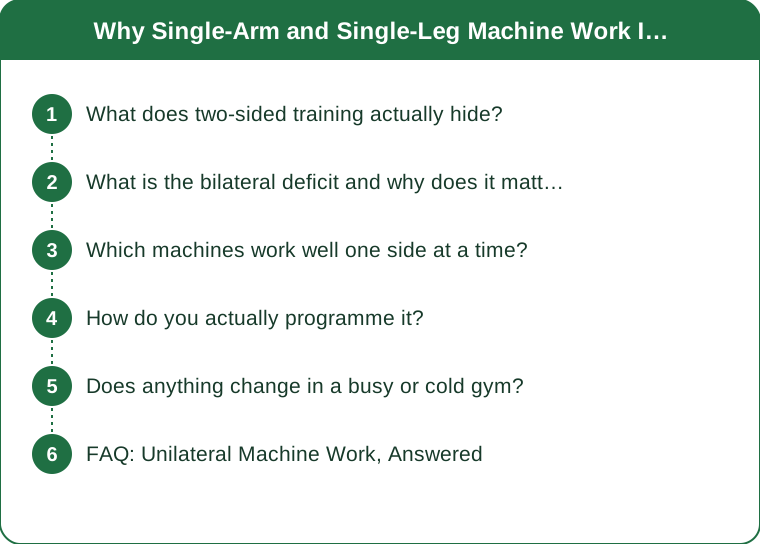
What does two-sided training actually hide?
More than most people realise, and machines hide it better than free weights do.
A bilateral movement lets the stronger side take over. On a two-legged leg press, a 15-20% difference between legs is entirely invisible - the platform moves, the weight goes up, and nothing tells you which leg did more of it.
Machines make this easier, not harder. A free weight version has some feedback - a barbell tips, a dumbbell lags. A machine’s fixed path removes even that signal, because the handle or platform moves in a straight line regardless of how unevenly it is being pushed.
Everyone has an imbalance and that is normal. Handedness, previous injury, sport history, and daily habits all contribute. Differences under about 10% are unremarkable. Beyond 10-15%, it starts affecting how you load bilateral lifts and, over time, where you feel discomfort.
Where it shows up eventually: one-sided lower back tightness, a hip that always feels tighter, a shoulder that always aches. Not because the difference is dangerous, but because compensating patterns accumulate.
And it caps your progress. On bilateral work, the weaker side often limits the load while the stronger side is under-stimulated. Both sides get a worse training effect than they would separately.
What is the bilateral deficit and why does it matter?
One of the more useful and less known findings in strength training.
The effect: the sum of what your two limbs produce separately is greater than what they produce together. Press with one leg, then the other, add the numbers, and the total exceeds what you can press with both. The gap is commonly 5-25% depending on the movement and the person.
The practical implication: unilateral training lets you produce more force per limb than bilateral training does. Each leg gets a bigger stimulus than it does at the same relative bilateral load.
Why it happens is not fully settled - likely a combination of neural inhibition when both sides fire simultaneously and stabilisation demands - but the effect itself is well documented and easy to observe on yourself.
A rough test you can do today: work out your ten-rep weight on a two-legged leg press. Then find your ten-rep weight single-legged. If the single-leg number is more than half the bilateral number, you have just measured your own bilateral deficit.
What this does not mean: that you should abandon bilateral work. Heavy two-sided lifts still build the most total load capacity and are more time efficient. Unilateral work is a complement, not a replacement - roughly a third to a half of your machine work is a sensible share.
Which machines work well one side at a time?
Most of them, and some better than their bilateral version.
Leg press: excellent. Foot in the centre of the platform, reduce the weight to well under half, and go slowly. This is the single most revealing unilateral machine exercise - most people find a difference immediately.
Leg curl and leg extension: excellent and easy. Both are designed to work one leg at a time with no modification.
Cable machines: the best category overall. Every cable movement can be done one arm at a time, and single-arm cable work adds a rotational and anti-rotation demand that the two-armed version does not have. Single-arm rows, presses, pulldowns, and pressdowns are all better than their bilateral versions for most purposes.
Chest press and shoulder press: good on machines with independent arms. On a machine with a single joined handle, it does not work.
Lat pulldown: use a single handle attachment. Genuinely different from the bar version and it exposes a lot.
Plate-loaded machines with independent arms are ideal - they were designed for this.
What does not work: anything with a joined bar or a single fixed handle, and the Smith machine. Also be careful with any seated machine where working one side pulls you sideways in the seat - hold the handle with the free hand and brace.

How do you actually programme it?
Five rules that make the difference between useful and pointless.
1. Always start with the weaker side. Non-negotiable. You will be fresher, and you get a true reading rather than one fatigued by the stronger side’s set.
2. Match the stronger side to whatever the weaker one managed. If the left does 8 and the right could do 11, the right does 8. This is how the gap closes - and it is the rule people find hardest, because leaving reps on the table feels wasteful.
3. Do not chase perfect symmetry. Under 10% difference is normal and forcing exact matching wastes training. The goal is to close a large gap, not to eliminate a small one.
4. Expect roughly half the bilateral weight, or a bit less. On a leg press, if you use 100kg with two legs, start around 35-40kg single-legged rather than 50. Stabilisation demands are much higher and the first session will surprise you.
5. Budget the time. Unilateral work takes roughly twice as long per exercise. Do two or three exercises unilaterally rather than the whole session - the leg press, one row or pulldown, and one press covers most of the value.
How long until it changes anything? For a genuine strength imbalance, eight to twelve weeks of consistent unilateral work. Neural improvements come faster; actual muscle differences take longer.
Does anything change in a busy or cold gym?
Two practical points, both seasonal.
Unilateral work is a good answer to a busy gym. From September onwards gyms fill up, and holding one machine for a longer set is often easier than moving between three. You occupy one station and use it fully.
But it does mean longer occupancy. Offer to let people work in - a unilateral leg press set genuinely takes a while, and the etiquette matters more when it is busy.
Cold gyms need more warm-up for unilateral work specifically. Balancing on one leg with load requires more stabiliser activity, and cold stabilisers are less responsive. Add a set at a very light weight before your working sets.
The first set will feel disproportionately hard when you are cold. This is normal and it is more pronounced on unilateral work than bilateral - do not judge your capacity by it.
A seasonal argument for starting now: if you have been training outdoors or on holiday over summer, you have likely accumulated some asymmetry from running, cycling, or simply a less structured summer. Autumn is when most people return to structured indoor training. Assessing side-to-side differences at the start of that block is far more useful than discovering them in February.
When to see a professional: a large difference accompanied by pain, a limb that feels weak rather than just weaker, or numbness is worth having assessed rather than trained around. This is general information, not medical advice.
FAQ: Unilateral Machine Work, Answered
How big a difference is a problem?
Under 10% is normal. 10-15% is worth addressing. Over 20% is worth investigating, especially if it is new or accompanied by discomfort.
Should I do more sets on the weaker side?
A common approach, and it works - one extra set on the weaker side for a training block. Do not overdo it; a permanently unequal programme creates its own problems.
Does this replace bilateral training?
No. Heavy bilateral lifts remain the most efficient way to build total strength. Use unilateral work for a third to half of your machine volume.
Why does it feel so much harder than half the weight?
Stabilisation. Your core, hips, and the muscles resisting rotation are all working much harder in a single-limb movement, and that work does not show on the weight stack.
Is it worth it if I have no obvious imbalance?
Yes - for the bilateral deficit effect alone, and because you may not have an obvious imbalance precisely because bilateral work hides it. Test before concluding.
Which single exercise should I start with?
Single-leg press. Most revealing, easiest to set up, and it needs no new equipment.
TL;DR:
- Machines hide side-to-side differences better than free weights do, because the fixed path removes all feedback.
- The bilateral deficit means each limb produces 5-25% more force alone than as half a pair - unilateral work gives a bigger per-limb stimulus.
- Best candidates: leg press, leg curl, leg extension, every cable movement, and independent-arm machines.
- Start with the weaker side, and match the stronger side to what it managed. That is the whole method.
- Expect 35-40% of your bilateral weight, not 50% - stabilisation is the difference.
- Under 10% difference is normal. Give it eight to twelve weeks to change anything real.
It is a change that costs time and no money, tells you something you did not know within one session, and quietly fixes a limitation most people never find out they had.
Keep Reading
This article is for general informational and styling purposes only. Fit, sizing, and product availability may vary.