Why Gym Machines Genuinely Feel Easier Than Free Weights at the Same Stated Weight
Quick Answer: A machine at 200 lb genuinely feels easier than 200 lb of free weight, and that’s mechanics, not weakness. The machine’s fixed path removes the stabilizing work your body would otherwise do, and that stabilization burns real effort that never appears in the number on the plate. Same number, different total demand.
You leg press a stack that would make your gym bag proud. Then you load a barbell with far less than that, squat it, and your legs file a complaint by rep four.
Nothing is wrong with you. The two numbers were never measuring the same thing.

Why Do Machines Feel Easier Than Free Weights at the Same Weight?
Because a machine only asks you to move the load along one path, and it holds that path for you.
A free weight asks you to move the load and keep it from going anywhere else — forward, backward, sideways, rotating. That control work is done by dozens of smaller stabilizing muscles, and it costs real energy and real effort. None of it shows up in the weight number.
So “200 lb” on a machine and “200 lb” on a bar describe the same gravitational load and two genuinely different total demands. The identical number is doing a lot of misleading work.
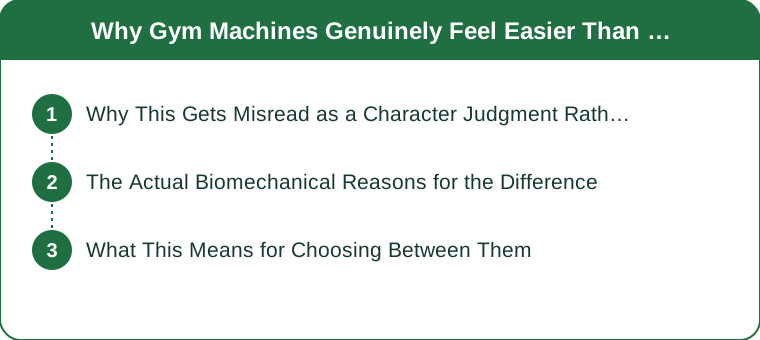
Why Does This Get Read as a Character Flaw Instead of a Mechanical Fact?
This is the part that quietly bothers people, so it’s worth saying plainly.
Gym culture treats free weights as the serious version and machines as the training-wheels version. So when the barbell number comes in far lower, the story people tell themselves isn’t “different stabilization demand” — it’s “I’m not as strong as I thought,” or worse, “I’ve been cheating.”
Neither is true. You weren’t inflating anything on the leg press. You were doing an exercise that legitimately removes one category of demand, and you got the result that exercise gives.
The mechanical framing is also more useful, because it tells you what to do next. “I’m weak” gives you nothing to train. “My stabilizers haven’t been trained because the machine did that job” gives you a plan.

What Are the Actual Biomechanical Reasons for the Gap?
Three specific mechanisms, all of them real:
1. Path stabilization is eliminated. The machine’s rails or lever arms physically prevent the load from deviating. Your body doesn’t have to prevent anything. With a free weight, every direction the load could go is a direction something in you is actively resisting.
2. Balance and proprioception demand disappears. Under a bar you’re also managing your own center of mass over your feet, continuously, with small ankle and hip corrections. Seated in a machine with your back braced, that entire task is outsourced to the frame.
3. Coordination between prime movers and stabilizers is a separate trainable skill. It isn’t automatic and it doesn’t come free with bigger quads. Machines never require it, so machine training never develops it — which is exactly why the transfer isn’t one-to-one.
Put those together and the same number represents meaningfully different work. Not a little different. Categorically different.
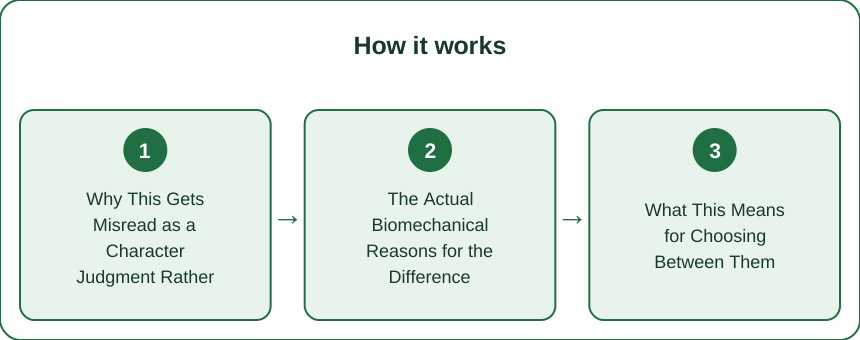
What Nobody Tells You About the Machine-vs-Free-Weight Debate
Nobody mentions that the numbers aren’t comparable across machines either. Two leg press machines from different manufacturers can have different lever ratios and sled angles, so 200 lb on one isn’t 200 lb of felt effort on the other. If you switch gyms and your press number drops, that’s usually geometry.
Nobody mentions that the machine’s “easier” is sometimes the point. If you’re trying to fatigue a specific muscle without your lower back or your balance quitting first, removing the stabilization demand isn’t a compromise. It’s the feature you’re paying for.
And nobody mentions that neither tool is the harder one in general. They’re harder in different places.
So How Should You Actually Choose Between Them?
Match the tool to the goal instead of ranking them:
- Use machines when the goal is isolating a target muscle and you don’t want stabilizers to become the limiting factor. Beginners building a base, anyone training around an injury, and anyone chasing muscle-specific fatigue all get real value here. Lower coordination demand also means lower technique-failure risk.
- Use free weights when stabilization itself is part of the goal — functional strength, real-world lifting and carrying, athletic transfer. Here the stabilization demand isn’t overhead; it’s the training effect.
- Don’t expect immediate transfer. Machine-built strength gives you a base, but the coordination piece needs its own progressive build. Start free-weight versions considerably lighter than your machine numbers suggest and progress from there. That’s not a step backward — it’s a different lift.
One practical note: free-weight work exposes you to more movement, so it also exposes bad gear. Anything that slides, rolls at the waist, or pulls your attention mid-set is a genuine distraction under a bar. Fitted training pieces — squat-proof high waist leggings, a top that stays put through a hinge — solve a small problem that feels large at rep eight.
FAQ
Is my leg press number meaningless then?
Not meaningless — just not convertible. It’s a valid measure of progress on that machine over time. Compare it to your own past leg press numbers, never to a barbell number.
Should beginners start on machines or free weights?
Either works, and many people do both. Machines shorten the technique learning curve; free weights build coordination sooner. A common approach is machines for volume and isolation, one or two free-weight compounds for the skill.
How much lighter should I go when moving to free weights?
Considerably — often less than half your machine load for an equivalent movement, at first. Pick a weight you can control cleanly for 8–10 reps and progress from there rather than trying to match a number.
TL;DR
- The gap is mechanical, not a strength or character problem. Machines remove stabilization work; free weights charge you for it.
- Three causes: guided path, no balance demand, no prime-mover/stabilizer coordination requirement.
- Never compare stated weights across the two. Compare each against its own history.
- Machines for isolation and lower risk; free weights when stabilization is the goal. Progress between them gradually.
Keep Reading
This article is for general informational and styling purposes only. Fit, sizing, and product availability may vary.