Why the Same Machine Feels Heavier in a Cold Gym
Quick Answer: Cold reduces muscle force output by roughly 2 to 5 percent per degree of muscle temperature, stiffens the machine’s own cables and bearings, and thickens the lubricant in the weight stack guide rods - so the same pin position genuinely requires more effort in a cold gym. It is not entirely in your head, but most of it is you rather than the machine. A proper warm-up recovers nearly all of it.
The practical implication: judge your progress by warm sets, never by the first set of a cold session.

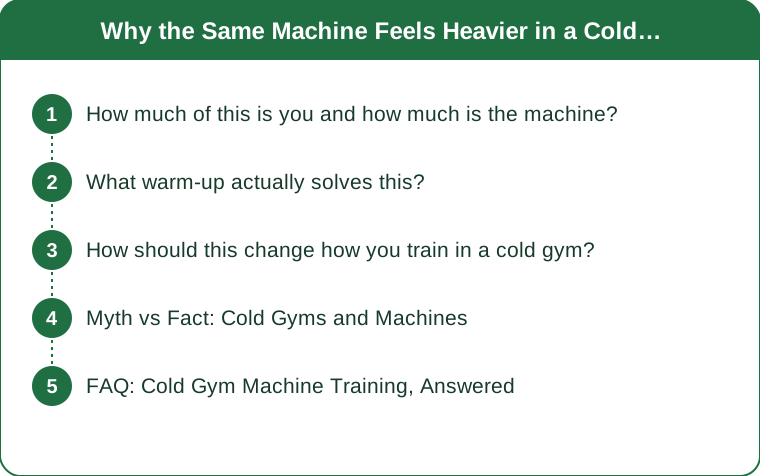
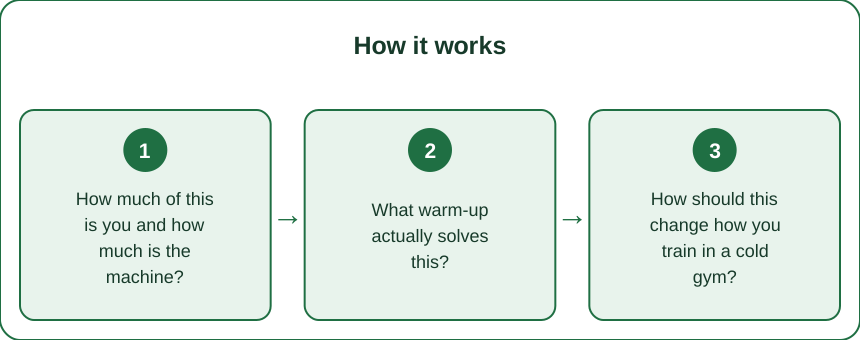
How much of this is you and how much is the machine?
Mostly you, but the machine is a genuine contributor and nobody mentions it.
Your side of it:
- Muscle force output falls with muscle temperature - roughly 2 to 5 percent per degree Celsius. A few degrees of muscle temperature is a meaningful difference in what you can lift
- Reduced joint range of motion means you work through a shorter, less mechanically efficient path
- Slower neuromuscular activation, so you recruit fewer fibres in the first seconds of a set
- Higher perceived exertion at the same actual load, which is a genuine effect and not just perception
The machine’s side, which is real:
- Lubricant on guide rods thickens as temperature drops, increasing friction on the stack
- Cables and pulleys stiffen slightly in the cold
- Bearings and bushings have higher rolling resistance when cold
- Upholstery and padding are firmer, which changes your position slightly
How much the machine contributes. Realistically a few percent in an unheated or poorly heated gym, more in a garage or outbuilding gym that genuinely gets cold. Enough to notice on a light warm-up set, not enough to explain a heavy set feeling hard.
The variable people never consider: which machine. Two nominally identical machines can differ by 5 to 10 percent in effective resistance because of wear, lubrication, and cable condition. If you moved to a different machine of the same type, that could be the whole explanation - and it is far more likely than a strength change.
Other reasons the same weight feels different day to day:
- Sleep the night before, which affects force output more than most people credit
- Time of day. Strength typically peaks in the late afternoon and is lowest early in the morning
- Where the exercise sits in your session and what preceded it
- Hydration, since even mild dehydration reduces performance measurably
- Seat position. A seat one notch different changes leverage significantly, and this is the single most common unrecognised cause
What warm-up actually solves this?
Ten minutes of general warming plus specific ramp-up sets, which is more than most people do in a cold gym.
The general phase, 5 to 8 minutes:
- Any continuous activity that raises core temperature - bike, rower, brisk walking on an incline
- Long enough to feel genuinely warm, which in a cold gym takes longer than the summer three minutes
- Light sweat is the useful marker. If you are not slightly warm, you are not warmed up
The specific phase, which does most of the work for machine training:
- Ramp sets on the first exercise. 50 percent for 10 reps, 70 percent for 5, 85 percent for 3, then your working weight
- This warms the specific muscles and grooves the movement pattern in a way general cardio does not
- In a cold gym, add one extra ramp set rather than jumping straight in
- Later exercises need less, since you are already warm - one ramp set is usually enough
Warming the machine, which is worth 30 seconds:
- Do a set of 10 with the lightest pin setting before your first real set. This moves the lubricant on the guide rods and frees the cables
- The difference is small but it is free, and it also lets you check the seat position
- On a cable machine, run the cable through its full range a few times
Why the first set of the session is not a fair test:
- You are least warm at exactly the moment you most want a number
- The postactivation effect means later sets often feel easier at the same weight
- Judging strength or progress by set one is systematically misleading, and it is the set people remember
The practical rule. Compare set two or three of an exercise across sessions, not set one. If you are tracking properly, note the conditions - cold gym, early morning, poor sleep - alongside the numbers, because otherwise a run of cold winter mornings reads as a plateau that is not there.
On cold-gym safety. Cold tissue is more injury-prone, particularly in the shoulders, lower back, and hamstrings. Machines are more forgiving than free weights here because they control the movement path, which is one genuine argument for machine-heavy sessions in a cold gym.

How should this change how you train in a cold gym?
Order things differently and adjust expectations, rather than fighting it.
Session ordering that works better in the cold:
- Start with machines rather than free weights. The controlled path is safer on cold tissue and warms you up for the free weight work
- Do your heaviest work in the middle of the session, not the beginning. You will be genuinely stronger 20 minutes in
- Leave any maximal or testing work for later in the session, or for a warmer day
- Finish with anything mobility-focused, when tissue is warm and the work is more productive
Load adjustments that are sensible rather than defeatist:
- Expect 5 to 10 percent less on the first exercise in a genuinely cold gym
- Use the same weight with fewer reps, rather than dropping the weight - this preserves the training stimulus more effectively
- Or use RPE rather than fixed loads. Training to a perceived effort automatically adjusts for how you feel that day
- Do not force a planned number in a cold session. It is how form breaks down
What is worth doing in cold sessions:
- Volume work at moderate loads, which is less affected by cold than maximal effort
- Technique refinement, since machines let you focus on execution
- Unilateral work, which is lower-load by nature and addresses imbalances
- Machine-based accessory work, which is exactly what most programmes are short of
Practical things that help in a cold gym:
- Keep a layer on for the first two exercises and remove it once warm
- Longer rest periods make you colder. In a cold gym, 90 seconds between sets is better than three minutes for staying warm, if the training goal allows
- Keep moving between sets rather than sitting - light walking or arm swings
- Warm hands, since grip strength drops measurably with hand temperature and grip limits pulling exercises before the target muscle does
The most important adjustment is expectation. A cold-gym session at 90 percent of your usual numbers is a completely normal session, not a bad one. People who track only load and not conditions spend the whole winter believing they are regressing when they are simply cold.
Myth vs Fact: Cold Gyms and Machines
Myth: The weight stack is the same so it must be you. Fact: Partly you, but the machine genuinely contributes. Thickened lubricant on guide rods, stiffer cables, and colder bearings add a few percent of resistance. It is smaller than the physiological effect but it is real, and thirty seconds of light reps frees most of it up.
Myth: Two machines of the same model give the same resistance. Fact: They can differ by 5 to 10 percent depending on wear, lubrication, and cable condition. If a weight suddenly feels different, check whether you are on a different machine before concluding anything about yourself.
Myth: Your first set is a good gauge of how strong you are that day. Fact: It is the least representative set of the session. You are coldest and least activated at exactly the moment you want the number. Compare set two or three across sessions instead.
Myth: A longer rest is always better between sets. Fact: In a cold gym, long rests let you cool down substantially, and you start the next set colder. Shorter rests or light movement between sets keeps you warm, provided the training goal allows it.
Myth: General cardio is enough of a warm-up before machines. Fact: It raises core temperature but does not prepare the specific movement pattern or muscles. Ramp sets on the actual exercise are what makes the working sets feel normal, and they are the part people skip.
FAQ: Cold Gym Machine Training, Answered
Why does the same weight feel heavier in a cold gym?
Mostly reduced muscle force output, which falls a few percent per degree of muscle temperature, plus slower activation and reduced range of motion. The machine adds a smaller real contribution through thickened lubricant and stiffer cables.
Does warming up actually recover the difference?
Nearly all of it. Five to eight minutes of general warming plus ramp sets on the exercise itself brings working sets back to normal. In a cold gym, add one extra ramp set rather than jumping in.
Should I lower the weight on cold days?
Better to keep the weight and reduce the reps, which preserves the training stimulus. Alternatively train to a perceived effort rather than a fixed load, which self-adjusts for how you feel.
Why does one leg press feel heavier than the identical one next to it?
Wear, lubrication, and cable condition can differ by 5 to 10 percent between nominally identical machines. If a weight suddenly changes, check the machine before questioning yourself.
Is it safe to train heavy in a cold gym?
Safer on machines than free weights, because the movement path is controlled. Warm up properly regardless, and move maximal or testing work to the middle of the session rather than the start.
Should I rest less between sets in a cold gym?
If your training goal allows, yes - long rests let you cool substantially so you start the next set colder. Otherwise keep moving between sets with light walking or arm swings rather than sitting still.
TL;DR:
- Muscle force output falls a few percent per degree of muscle temperature - the effect is real, not perceptual
- The machine contributes too: thickened lubricant, stiffer cables, colder bearings. Do a light set to free it up
- Two identical machines can differ by 5 to 10 percent, which explains more sudden changes than people think
- Warm up 5 to 8 minutes generally, then ramp sets on the exercise itself, plus one extra set in a cold gym
- Compare set two or three across sessions, never set one - it is the least representative set you do
A cold-gym session at 90 percent of your usual numbers is a normal session. Record the conditions alongside the load and the winter stops looking like a plateau.
Keep Reading
This article is for general informational and styling purposes only. Fit, sizing, and product availability may vary.