Why Machine Weight Numbers Differ Between Brands and Machines
Quick Answer: Machine numbers are not standardized measurements - they are labels filtered through each machine’s mechanics. Pulley arrangements can halve the effective load (a 2:1 ratio makes 100 feel like 50), cam shapes redistribute resistance through the range, lever geometry changes what a plate weighs at the handle, and friction plus maintenance age every machine differently. The number is only comparable to itself: log per-machine with seat settings noted, judge progress by reps and control at the same station, and never carry a number between brands and expect it to mean the same thing.
Every lifter eventually hits the puzzle: seated row at 70 feels easy, lat pulldown at 70 feels impossible, and the leg press at the other gym flatly disagrees with the one at home. Nothing is wrong with you - the numbers were never speaking the same language.

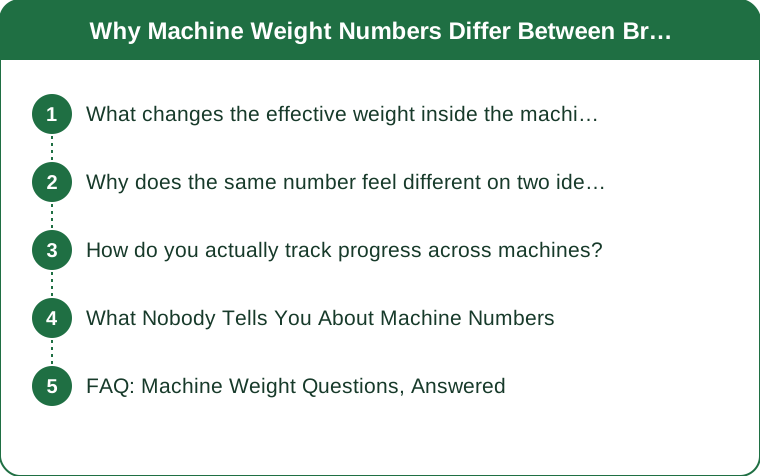
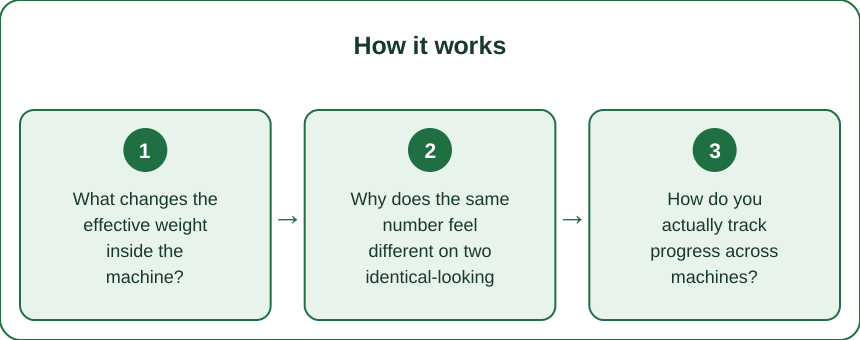
What changes the effective weight inside the machine?
Four mechanical translators sit between the stack and your hands.
Pulley ratios are the big one. Many cable machines - especially dual-adjustable functional trainers - run a 2:1 arrangement: the cable travels twice as far as the stack rises, and you feel roughly half the pinned weight. Pin 100, feel about 50. Some machines run 1:1, a few run other ratios entirely, and manufacturers do not print it on the tower. This single fact explains most of the that-cable-station-feels-weirdly-light experiences in any gym.
Cams reshape the resistance curve. The kidney-shaped wheel the belt wraps around is a deliberate design tool: as it rotates, the effective lever changes, making the same stack feel lighter or heavier at different points in the range. Done well, it matches resistance to where your muscle is strong. Done differently by two brands on the same exercise, it makes their 60s feel like different exercises - because mechanically, they are.
Lever arms translate plate weight on plate-loaded machines. On a leverage press or row, a plate’s contribution depends on where it sits along the arm and the machine’s geometry - 90 pounds loaded can deliver well over or under 90 at the handles, before counting the arm’s own unlisted weight.
And friction plus age is the wild card. Worn bushings, dry guide rods, older cables, and belt condition all add resistance - more on the lift, occasionally less on the lowering. Two identical machines, one new and one ten years into service, genuinely resist differently at the same pin.
The conclusion is liberating rather than annoying: the number was never a measurement of you. It is a setting on one specific piece of hardware.
Why does the same number feel different on two identical-looking machines?
Because identical-looking is doing heavy lifting in that sentence.
Different brands, same exercise, different machinery. Two chest press machines can differ in cam profile, handle path (converging versus straight), seat geometry, and starting resistance - the 40 on each is answering a different physics question. Between brands, expect numbers to move by twenty percent or more, in either direction, and treat every unfamiliar machine as new territory.
The stack units might literally differ. Plenty of equipment ships with kilogram stacks, and a gym floor can mix them with pound stacks unlabeled. A 50 pin on a kilo stack is 110 pounds - the classic explanation for a machine that feels savagely heavier at the same number. One glance at the stack’s engraving settles it.
Your seat settings are part of the machine. Seat height and pad position change your leverage against the machine’s - a chest press with handles an inch too high recruits shoulders and feels a full plate harder. The number on the pin never changed; your position in the mechanism did. This is why logging settings alongside weight is non-negotiable for meaningful tracking.
Maintenance history is invisible and real. The just-serviced machine glides; its twin by the window, cables stretched and rods dry, adds phantom resistance. Regulars unconsciously know which copy of a machine runs heavy - now you know why they queue for one of the pair.
Even your clothing interacts with the hardware. Slick shorts on a vinyl leg press seat mean sliding and re-bracing between reps, which reads as the weight feeling unstable; grippier leggings that plant you on the pad let the same pin move like it should. Small input, surprisingly large difference on pressing machines.
Sum: the machine, the settings, the units, the maintenance, and your interface with the seat all sit inside that one number. Comparing it across stations was always a category error.

How do you actually track progress across machines?
By making the number local and the standards portable.
Log per-machine, with settings. The entry that works: machine name or location, seat and pad positions, pin number, reps, and a one-word quality note. Chest press by the pillar, seat 4, pin 8, 12 reps, smooth. Next session, that line rebuilds your exact setup in ten seconds - and progress measured against it is real progress, whatever the pin claims in absolute terms.
Photograph the settings once. A three-second photo of the seat markings and pin beats any memory, especially across a two-machine rotation or a gym with duplicate stations that do not match.
Judge by performance standards that travel. Reps at the same control and range, tempo held, the last two reps hard but clean - these transfer between any hardware. When a strange machine at a strange gym offers strange numbers, calibrate by feel: pick a pin that allows your usual reps at your usual effort, note it for that location, and carry on. Effort is the universal unit; the pin is a local dialect.
Progress on machines counts completely, while numbers stay local. Adding reps, then pin plates, at a fixed setting on a fixed machine is textbook progressive overload - machines build muscle exactly as well as the number-purists’ barbells for most goals. What does not count is the imaginary gain from switching to a machine with friendlier math.
Handle the between-pin gap with the add-on tools. Stack jumps of ten-plus pounds are brutal in relative terms on smaller movements; magnetic add-on plates (many gyms have them at the desk, or they cost little to own) create the small jumps that keep progress moving.
And when traveling: same muscles, same effort, zero number loyalty. The vacation gym’s lat pulldown owes your home gym’s numbers nothing - and vice versa.
What Nobody Tells You About Machine Numbers
Asking staff for the pulley ratio is a normal question. Trainers and floor staff usually know which cable stations run 2:1, and the manufacturer’s manual - often findable in thirty seconds online - states it outright. Knowing the ratio converts a confusing station into an honest one, and nobody who asks has ever been the silliest question of the desk’s day.
The stack has unlisted passengers. The selector rod, pulleys, and top plate add resistance the printed numbers ignore; some machines also carry meaningful starting tension before the first plate moves. This is why the lightest pin on some machines is not actually light - relevant when rehabbing or warming up, and another reason absolute numbers deserve no reverence.
Plate-loaded machines lie in the friendliest direction. Leverage geometry means loaded plates often deliver less resistance at the handle than their face value, which is how leg press numbers inflate egos gym-wide. Enjoy the big plates; just log them as local currency.
Machine number inflation is a marketing choice some brands make - equipment that flatters sells memberships and units. Neither flattering nor punishing calibration matters once you track locally; both matter enormously if you let the pin number be your self-esteem.
The mixed-unit floor is more common than anyone admits. Gyms assemble equipment over years from different suppliers; kilo stacks and pound stacks coexist unlabeled a few feet apart. The engraving on the top plate is the only truth.
And the deepest reframe: machines were never trying to measure you. They are resistance-delivery appliances. The barbell’s numbers are standardized because plates are plates; the machine’s numbers are settings, like a toaster dial. Track the toast, not the dial - reps, control, and the trend line at your own stations are the entire scoreboard that matters.
FAQ: Machine Weight Questions, Answered
Are gym machine weights accurate?
The stack plates themselves are usually close to their stamped weight - but pulley ratios, cams, lever geometry, friction, and starting tension mean the resistance at your hands can differ from the pin by large margins in either direction. Treat the number as a machine-specific setting rather than a measurement, and it stops mattering.
Why is 100 on the cable row so much easier than 100 on the lat pulldown?
Different machines, different mechanics - most commonly a 2:1 pulley ratio on one station halving the effective load, plus different cam profiles and friction. Same-number comparisons across stations are category errors; each machine’s numbers only mean something relative to themselves.
Should my machine weights match my dumbbell weights?
No - and they will not. Machines stabilize the load for you, change leverage through the range, and translate stack weight through their mechanics, so machine numbers typically run higher than free-weight numbers for the same muscle at the same effort. Log the two worlds separately and let each progress on its own line.
Do machine workouts count as real strength training?
Completely. Progressive overload - more reps, then more load, at consistent settings and control - builds muscle and strength on machines exactly as the principle intends, with a gentler learning curve and built-in safety for training close to failure. The only thing machines do worse than barbells is generate comparable numbers between gyms - which is a bookkeeping quirk, not a results problem.
TL;DR:
- Machine numbers are settings, not measurements - pulleys (often 2:1), cams, levers, and friction all translate them.
- Same number, different machine, different truth - and some stacks are kilos while their neighbors are pounds.
- Log per-machine with seat settings; judge progress by reps and control at your own stations.
- Magnetic add-on plates fix the big between-pin jumps; grippy leggings fix the sliding-seat wobble.
- Ask staff for pulley ratios, check stack engravings, and give vacation-gym numbers zero loyalty.
The pin was never grading you. It was labeling a pulley - and the only scoreboard that ever mattered is your own logbook at your own stations.
See It in Motion
Seen here: Super High Waist Embossed Yoga Leggings with Inner Pocket — shop it on bubblelime.com
Keep Reading
This article is for general informational and styling purposes only. Fit, sizing, and product availability may vary.