Smith Machine vs Free Barbell Squat: What's Actually Different?
Quick Answer: A Smith machine locks the bar to a fixed vertical (or slightly angled) path, removing the need for balance and stabilizer engagement that a free barbell squat requires. This makes the Smith machine version safer for beginners learning depth and control, but it trains a meaningfully different, less functional movement pattern than a free squat.
Both are ‘squats’ in name, but the fixed bar path changes what your body is actually being asked to do.

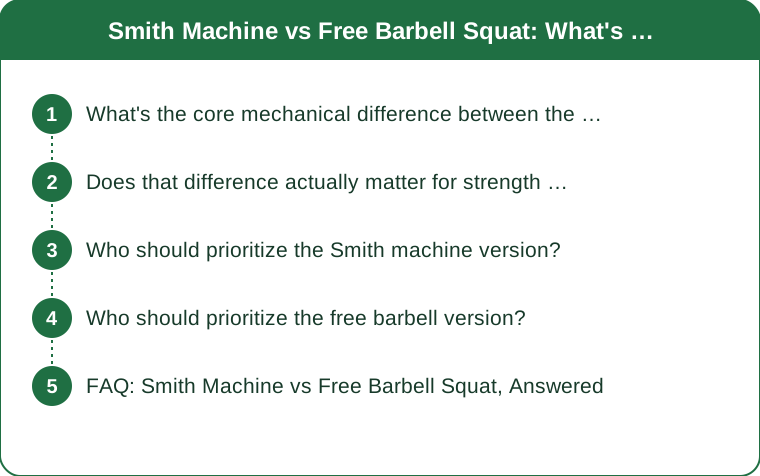
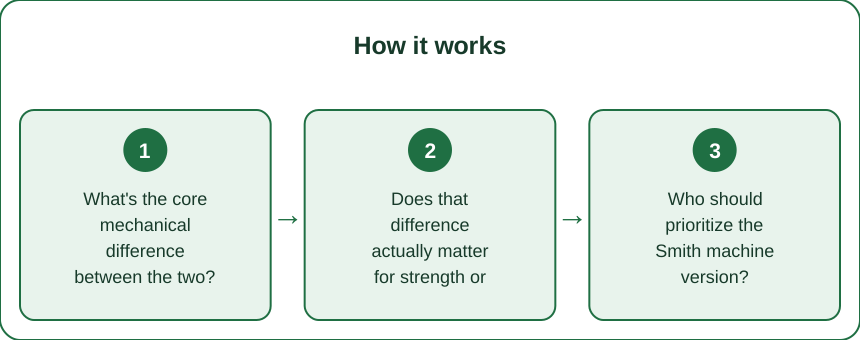
What’s the core mechanical difference between the two?
A free barbell squat requires your whole body — core, hips, ankles, stabilizer muscles — to balance the bar’s path through the entire movement, since nothing but your own control keeps the bar tracking correctly. A Smith machine fixes the bar to a vertical or slightly angled rail, removing that balance requirement entirely and letting you focus purely on the up-down squatting motion itself.
Does that difference actually matter for strength or muscle building?
For pure quad, glute, and hamstring muscle activation, both versions work the target muscles effectively, and some research shows the Smith machine can even allow slightly heavier loading safely, since stabilization isn’t diverting effort. Where it matters more is functional carryover — real-world movement, sports performance, and general balance and stabilizer strength benefit more from the free version, since daily life and most other lifts never move along a perfectly fixed path.

Who should prioritize the Smith machine version?
Beginners still learning squat depth and knee tracking benefit from the reduced balance demand, since it isolates the depth and control learning curve from the added challenge of stabilization. Lifters training through an injury or those training alone without a spotter for heavy sets also commonly prefer the Smith machine’s built-in safety catches.
Who should prioritize the free barbell version?
Anyone training for sports performance, general functional strength, or long-term balanced lower-body development should prioritize free squats, since the stabilizer engagement is part of the actual training benefit, not just an obstacle to work around. Free squats also build the proprioception and control that carries over to daily movement in a way a fixed-path exercise structurally cannot replicate.
FAQ: Smith Machine vs Free Barbell Squat, Answered
Is the Smith machine squat bad for you?
No — it’s a legitimate, effective exercise with real advantages for certain goals and situations, just a different movement than a free squat rather than an inferior copy of it.
Should beginners start with the Smith machine before trying free squats?
It’s a reasonable approach for learning depth and control first, but transitioning to free squats before too long captures the balance and functional benefits a fixed path can’t provide.
Can I build the same size and strength with only Smith machine squats?
Muscle size gains can be comparable, but strength and skill that transfers to unstable, real-world, or sport-specific movement is better built with at least some free-weight training included.
TL;DR:
- The Smith machine fixes the bar path, removing the balance demand a free squat requires
- Muscle activation is similar between versions, but functional carryover favors free squats
- Beginners and solo lifters without a spotter often benefit from the Smith machine’s safety
- For sport performance or general functional strength, prioritize free barbell squats over time
Use the Smith machine to build depth and control confidence, then bring what you’ve learned to a free barbell for the balance and functional benefit it adds.
Keep Reading
This article is for general informational and styling purposes only. Fit, sizing, and product availability may vary.