5 Lat Pulldown Mistakes Turning Your Back Workout Into an Arm Workout
Quick Answer: If lat pulldowns fatigue your biceps more than your back, you’re likely pulling with your arms instead of initiating with your shoulder blades. Fix it by pulling your elbows down and back — think ‘elbows to hips’ — before your hands even move much.
You finish a set of lat pulldowns and your biceps are burning while your back feels… fine. That’s a form issue, not a strength issue, and it’s one of the most common machine mistakes in the gym.

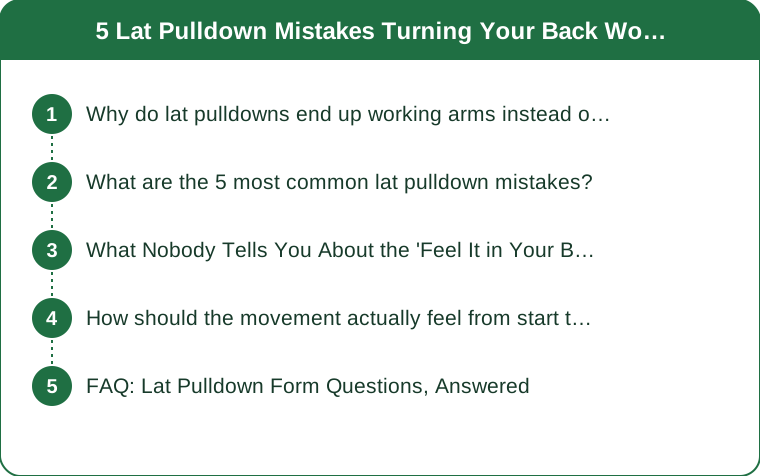
Why do lat pulldowns end up working arms instead of back?
This happens when the movement starts with elbow flexion (a bicep curl motion) instead of shoulder extension (pulling the arm down and back from the shoulder joint). If your first move is bending your elbows, your biceps take over the set before your lats ever fully engage.
The fix is a sequencing change: initiate the pull by driving your elbows down and back, almost like you’re trying to put them in your back pockets, before focusing on the handle position at all.
What are the 5 most common lat pulldown mistakes?
- Leaning back too far — a slight lean (10-15 degrees) is fine, but leaning back 45+ degrees turns the pull into a horizontal row that shifts load off your lats
- Pulling the bar too low, to your chest or below — stopping around chin-to-upper-chest level keeps tension on the lats; going lower recruits more lower back and momentum
- Using a death grip on the bar — gripping too hard over-activates forearms and biceps, stealing tension from your back; a lighter grip forces your back to do more work
- Letting the weight stack slam on the way up — a controlled negative (2-3 seconds) is where much of the muscle-building tension actually happens
- Grip too narrow or too wide by default — an overly narrow grip shifts emphasis toward biceps; shoulder-width-plus-a-bit is the standard starting point for most people

What Nobody Tells You About the ‘Feel It in Your Back’ Cue
Here’s what trainers rarely explain clearly: feeling your lats on a pulldown is partly a mind-muscle connection skill, not just a form fix. Even with perfect form, some people need weeks of deliberately focusing on their shoulder blades moving down and together before the sensation clicks.
A useful trick: do a few reps with zero weight on the cable, just moving your shoulder blades down and back with your arms relatively straight. That isolates the exact muscle action you’re trying to recruit before adding load back.
How should the movement actually feel from start to finish?
- Set up with a slight lean back, chest up, shoulder blades pulled down and slightly together before you even pull.
- Initiate by driving elbows down toward your hips — this should happen before your hands travel far.
- Pull to around chin or upper chest level, squeezing your shoulder blades together at the bottom.
- Release with control over 2-3 seconds, letting your shoulder blades stretch back up without letting the stack slam.
FAQ: Lat Pulldown Form Questions, Answered
Should you use a wide grip or close grip for lats specifically?
A slightly wider-than-shoulder grip generally emphasizes the lats best for most people; very wide grips can actually reduce range of motion and shift stress to the shoulders.
Is it normal to feel lat pulldowns in your forearms at all?
Some forearm engagement from gripping is normal and fine — the concern is only when forearms or biceps fatigue before your back does.
How much weight should a beginner start with on lat pulldowns?
Start light enough to complete 10-12 controlled reps while focusing entirely on the elbows-down cue — adding weight before the movement pattern is consistent just reinforces the arm-dominant mistake.
TL;DR:
- Arm fatigue instead of back fatigue almost always means you’re leading with elbow flexion, not shoulder extension
- Fix the sequence: drive elbows down and back first, let hand position follow
- Avoid leaning back too far, pulling too low, gripping too hard, and letting the stack slam up
- Try a few zero-weight reps to isolate the shoulder blade movement before adding load back
The cable and the exercise aren’t the problem — the sequence your body pulls in is, and it’s a fixable habit.
Keep Reading
This article is for general informational and styling purposes only. Fit, sizing, and product availability may vary.