Is the Machine Broken, or Am I Using It Wrong?
Quick Answer: Grinding, catching or jerky resistance through the range is usually the machine. Uneven left-to-right effort, pain at the joint, or a movement path that feels wrong is usually your setup. The single fastest diagnostic is to run the machine with no weight or the lightest plate — if it still catches empty, it is mechanical, and you should report it and use something else.
Most people default to assuming it is them, which means broken equipment stays broken and bad setups stay uncorrected.

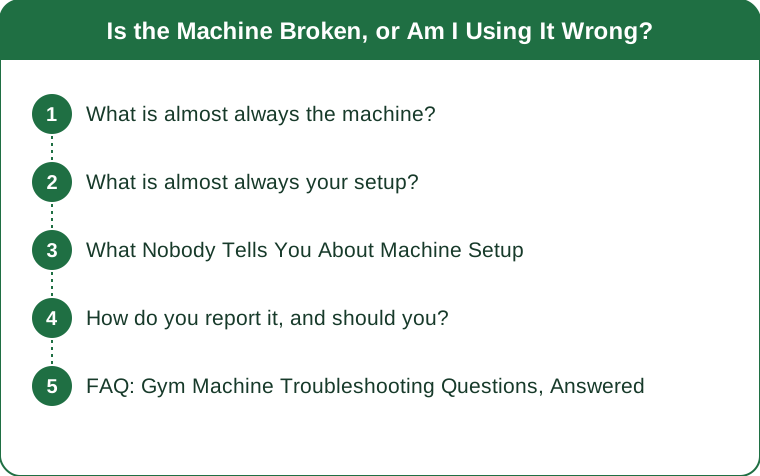
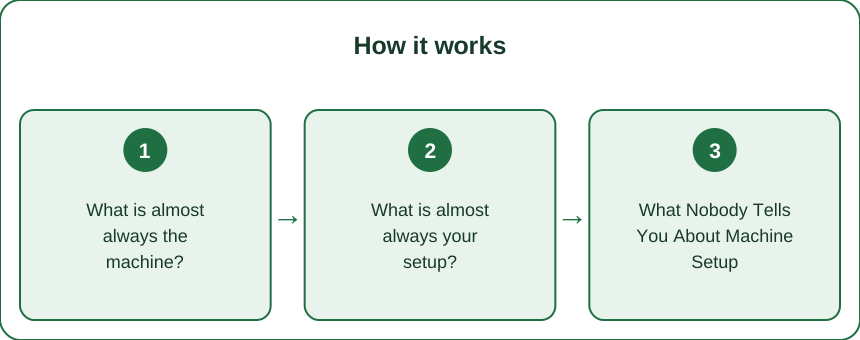
What is almost always the machine?
Six symptoms that indicate mechanical problems rather than user error.
Grinding or scraping through the movement. Guide rods needing lubrication, worn bushings, or debris in the track. It will feel gritty at a specific point in the range and will do it every rep.
A catch or hitch at one point. The weight stack momentarily sticks and then releases. Usually a cable fraying, a pulley bearing failing, or a bent guide rod. This is a genuine safety issue, because a stack that sticks and releases can drop suddenly.
Visible cable fraying. Look at the cable where it runs over the pulleys. Any visible broken strands means the machine should not be used. Report it.
A weight stack that rattles or clunks loudly. Often a worn bumper or a loose top plate. Usually noisy rather than dangerous, but worth reporting.
Resistance that is different in each direction beyond the expected. Machines have some inherent difference between concentric and eccentric feel, but if lowering feels dramatically lighter or heavier than lifting, something in the cable path is binding.
A pin that will not seat fully. Sometimes a bent pin, sometimes a damaged plate hole. Do not use a stack with a partially seated pin — that is exactly how plates come loose mid-set.
What is almost always your setup?
Five symptoms that point back at how the machine is adjusted for you.
One side working noticeably harder than the other. On a machine with a single weight stack and a fixed bar, this is nearly always positional — you are seated slightly off-center, or one hand is further out on the handle. Check your seat position and hand placement before concluding the machine is uneven.
Joint pain rather than muscle effort. Pain at the knee, shoulder or lower back during a machine exercise is a strong signal that the joint axis is not aligned with the machine’s pivot. Most machines have a marked pivot point; your joint should sit level with it. This is the single most common setup error.
The movement path feeling awkward or restricted. Usually seat height. A chest press with the handles above nipple height loads the shoulder differently than intended; a lat pulldown with the thigh pad too loose lets you lift off the seat.
Running out of range before the muscle is tired. Seat position again, or a starting position that has the muscle already shortened.
The same weight feeling different day to day. This is usually you — fatigue, sleep, warm-up state, time of day — not the machine. Machines are consistent; humans are not.
The pattern: mechanical problems are reproducible and identical every rep. Setup problems change when you change your position.

What Nobody Tells You About Machine Setup
The seat adjustment is not a comfort setting. It determines where your joint sits relative to the machine’s pivot, which determines which muscles are loaded and at what leverage. Two people using identical weight on a leg extension with different seat positions are doing measurably different exercises.
Most machines have their pivot point marked. A small dot, a bolt head, or a labeled axis on the side of the frame. Align your joint — knee for leg extension, elbow for arm curls, shoulder for lateral raises — with that point. This is printed on the machine placard on most modern equipment and almost nobody reads it.
Adjust before every set, not once per session. If you worked in with someone, or if you moved the seat for a different exercise, the position has changed. Experienced lifters check the adjustment every single time they sit down, which is one of the more visible differences between them and beginners.
The placard is worth reading. Every commercial machine has an instruction diagram showing the starting position and the movement path. It takes 20 seconds and eliminates most setup errors.
If a machine genuinely does not fit you, it does not fit you. Machines are built to fit a range of body sizes, and people outside that range — very tall, very short, unusually long or short limbs — will not get correct alignment on some machines regardless of adjustment. That is not a failure on your part, and the right answer is to use a different exercise rather than to force a bad position.
How do you report it, and should you?
Yes, and it takes 30 seconds.
Tell the staff at the desk on your way out. Name the machine, describe what it does, and say where in the range it does it. “The seated row catches about two thirds of the way through the pull” is far more actionable than “the row machine is weird.”
Do not just leave it. An intermittent catch that seems minor to you can drop a stack on someone else. Most gyms have a maintenance log and cannot fix what nobody reports.
Do not try to fix it yourself. Adjusting cables, tensioners or pulleys on commercial equipment is a job for a technician, and improvised fixes create liability and risk.
Put an out-of-order note on it if the gym provides them, or ask staff to. If a machine is genuinely unsafe — visible cable fraying, a stack that drops — mention it as urgent rather than as an aside.
And have your plan B ready. Every machine exercise has a free-weight or cable substitute. If the leg press is down, split squats and a hip hinge cover the pattern. Knowing your alternatives in advance is what turns a broken machine from a derailed session into a footnote.
FAQ: Gym Machine Troubleshooting Questions, Answered
The weight feels heavier than the number says. Is the machine wrong?
Usually not. Machines vary enormously in how the stack number relates to actual resistance at the handle, because of differing lever arms and pulley ratios. A 40 on one brand’s chest press is not a 40 on another’s. Compare within a machine, never across machines.
Should I use a machine that is noisy but works?
Noise alone is usually fine — worn bumpers and dry guide rods are noisy long before they are dangerous. Report it, and use judgment: noise plus catching, or noise plus visible cable wear, is a different situation.
How do I know if my alignment is right?
Set up, do one slow rep with minimal weight, and pay attention to where you feel it. Effort in the target muscle with no joint sensation means alignment is good. Pinching, clicking or joint discomfort means adjust and try again. Two minutes spent on this at the first session with a new machine saves months of working around a nagging joint.
Can I ask staff to show me how to set it up?
Yes, and it is a completely routine request that they field constantly. It is also the fastest way to get it right.
TL;DR:
- Grinding, catching, fraying cables and pins that will not seat are mechanical — report and use something else.
- Uneven left-right effort, joint pain and awkward paths are setup — usually seat position and joint-to-pivot alignment.
- Run the machine empty: if it still catches with no weight, it is the machine.
- Align your joint with the marked pivot point, read the placard, and re-check the seat every set.
- Report faults specifically, do not attempt repairs, and keep a plan B exercise for every station.
Assuming it is always you keeps broken equipment in service. Assuming it is always the machine keeps a bad setup in your program. The empty-machine test settles it in ten seconds.
Keep Reading
This article is for general informational and styling purposes only. Fit, sizing, and product availability may vary.