How the Cable Attachment You Grab Changes the Exercise Entirely
Quick Answer: The attachment determines your grip position, wrist freedom, and range of motion — and those three things change which muscles dominate. A rope allows the wrists to rotate and the hands to separate at the end range, which increases the contribution of the smaller stabilizers and lets you finish the movement fully. A straight bar locks the wrists and hands into a fixed relationship, which allows more load but limits end range. Neither is better; they answer different questions.
You’ve been doing cable pushdowns for four months with the straight bar and the movement feels fine.
Switch to the rope for one session and the same weight feels wrong, your triceps cramp at the bottom, and you’re not sure whether you got better or worse at the exercise. You got neither. You did a different exercise.


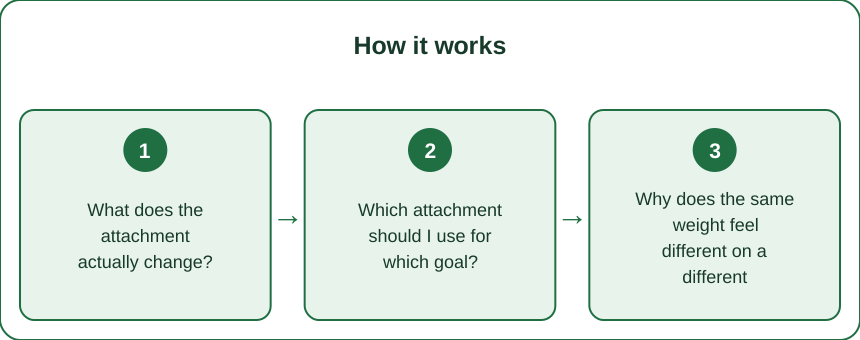
What does the attachment actually change?
Three things: where your wrists can go, whether your hands can move relative to each other, and how far the movement can travel at the end.
Wrist freedom determines forearm and grip involvement. A fixed bar holds the wrist in one position through the whole range, which is comfortable and lets you load heavier. A rope or a rotating handle lets the wrist find its natural path, which usually feels better on the joint and recruits more stabilizing muscle.
Hand separation matters more than people realize. With a bar, your hands are locked at a set distance. With a rope, they can spread apart at the finish — and that spread is what allows full contraction in movements like a pushdown, a face pull, or a straight-arm pulldown.
End range is where most of the difference lives. A bar pushdown ends when the bar hits your thighs. A rope pushdown ends when your arms are fully extended and separated, which is meaningfully further.
Load capacity runs the other way. The fixed relationship of a bar means less stabilization demand, which means you can generally handle 10 to 20% more weight with a bar than a rope on the same movement.
Which attachment should I use for which goal?
Straight bar: maximum load, simple pattern, progressive overload. This is your choice when the goal is to move more weight over time and track it cleanly. Pushdowns, curls, and upright rows all load well on a straight bar.
Rope: end-range contraction and joint comfort. Choose the rope when the point of the exercise is the squeeze at the finish — triceps pushdowns, face pulls, hammer curls, and straight-arm pulldowns. It’s also the default for anyone whose wrists or elbows complain on a fixed bar.
EZ / cambered bar: the compromise. The angled grip puts the wrist in a semi-pronated position that most people find far more comfortable for curls than a straight bar, with almost no loss in loadability.
Single D-handle: unilateral work and rotation. One arm at a time exposes side-to-side differences you cannot see with a bar, and the free hand lets the torso rotate naturally. For anyone who suspects an imbalance, this is the diagnostic tool.
Wide lat bar vs close V-grip on pulldowns: wide emphasizes the upper lats and teres, close-neutral shifts toward the lower lats and allows a longer pull. Both belong in a program; neither replaces the other.
Ankle strap: the only way to load hip abduction, adduction, and extension directly on a cable, and criminally underused for glute work.
Why does the same weight feel different on a different attachment?
Because the moment arm and the stabilization demand both changed, even though the number on the stack didn’t.
A rope adds a few inches of effective length to the cable, which subtly changes the angle at which force reaches your hands. Small changes in angle produce real changes in perceived load.
Stabilization is the bigger factor. With a rope, your body spends effort keeping the two ends balanced and controlling wrist rotation. That effort is real work, and it’s subtracted from what’s available for the prime mover.
Grip diameter changes force transmission. A thick handle recruits more forearm and reduces how much you can transmit to the target muscle — sometimes deliberately, as with fat-grip training.
So the correct response to ‘the rope feels heavier’ is to drop the weight, not to conclude you got weaker. A 15% reduction is a normal, expected adjustment when switching from a bar to a rope on the same movement.
Log the attachment alongside the weight. A training log that says ‘40 lbs pushdown’ without saying which attachment is a log you can’t actually progress from — and this is the most common gap in cable machine records.

5 Cable Attachment Mistakes Almost Everyone Makes
1. Treating the attachment as interchangeable in your log. You’ll conclude you’re stalling when you’ve actually been alternating between two different exercises. Write the attachment down. Every time.
2. Death-gripping the rope. The rope is designed so your hands can move. Squeezing it into a fixed shape converts it into a bad straight bar with worse leverage. Hold it firmly enough not to drop it and let the ends separate at the finish.
3. Choosing the widest bar available for lat pulldowns. A very wide grip shortens the range of motion and puts the shoulder in a more externally rotated, more vulnerable position at the top. Slightly wider than shoulder width is where most people get the best combination of range and safety.
4. Never using the single handle. Bilateral work hides asymmetry — the stronger side compensates automatically and you never find out. One unilateral session a month surfaces imbalances that two years of bar work would never reveal.
5. Ignoring where the pulley is set. The attachment gets all the attention and the pulley height changes the exercise at least as much. A rope face pull at eye height and the same rope at hip height train nearly opposite things. Set the pulley first, then choose the attachment.
How do I build a simple system for choosing?
Ask one question: is this exercise about the load or about the finish?
If it’s about load — you’re chasing weight on the stack, the movement is a compound pull or press, and you want a clean progression — take the fixed bar. Straight, EZ, or V-grip depending on comfort.
If it’s about the finish — the point is the contraction at the end, the muscle is small, the reps are higher — take the rope or the single handle.
Then match the pulley to the muscle’s line of pull. The cable should oppose the direction the muscle contracts. Triceps extend the elbow downward, so a high pulley. Rear delts pull backward at shoulder height, so an eye-level pulley. Glutes extend the hip, so a low pulley.
Keep one attachment constant within a training block. Change it between blocks, not between sessions. Eight weeks on the rope, then eight on the bar, gives you comparable data and a genuine change in stimulus.
Do a full audit once. Spend ten minutes at the attachment rack trying every handle on one movement at a light weight. Most people have never touched half of what their gym owns, and the useful ones tend to be the ones nobody puts back.
FAQ: Cable Attachment Questions, Answered
Is the rope better for triceps than the bar?
For the long head and end-range contraction, the rope has an edge because of the separation at the finish. For total load and progressive overload, the bar wins. Most well-built programs use both — bar for the heavy work, rope for the higher-rep finisher.
Should I buy my own attachments?
Only if your gym is genuinely missing something you need — a rope and a single D-handle are the two most commonly worn out or absent. They’re inexpensive and fit standard carabiners on almost any machine.
Why do the numbers on cable stacks not match dumbbells?
Pulley systems change the effective resistance, and different manufacturers use different pulley ratios. A 50 on one machine can feel like a 35 on another. Compare weights only within the same machine.
Does attachment choice matter for beginners?
Less than consistency does. In the first six months, pick whichever attachment feels comfortable on your joints, write it down, and progress. The nuance becomes worth optimizing around month eight or so.
TL;DR: Changing the attachment is changing the exercise, not adjusting it.
- The attachment controls wrist freedom, hand separation, and end range — the three things that decide which muscle dominates.
- Bar for load, rope for the finish. That one question answers most attachment choices.
- Expect roughly a 15% weight drop switching bar to rope. That’s normal, not a regression.
- Log the attachment with the weight, or your progression data is fiction.
- Set the pulley height first — it changes the exercise more than the handle does.
- Use the single handle monthly to find the side-to-side differences bilateral work hides.
Next session, do your usual pushdown with the attachment you never use. Ten reps at half your normal weight is enough to feel exactly what the handle was deciding for you.
Keep Reading
This article is for general informational and styling purposes only. Fit, sizing, and product availability may vary.