The Assisted Pull-Up Machine Mistake That's Wasting Your Progress
Quick Answer: The assisted pull-up machine’s weight setting represents how much help you’re getting, not how much you’re lifting — a higher number means more assistance and an easier rep, which is the opposite of how most other gym machines work. Setting it too high and never lowering it over time is the most common reason progress stalls.
The assisted pull-up machine is one of the most misunderstood pieces of gym equipment, largely because its weight stack works backwards from every other machine you’ve used.
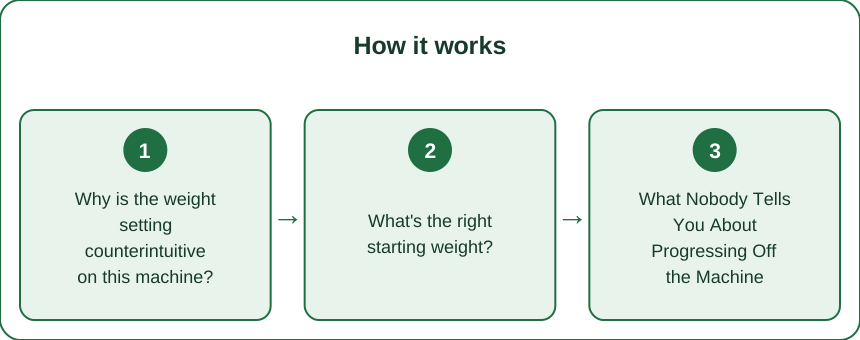
Why is the weight setting counterintuitive on this machine?
On a leg press or chest press, a higher number means more resistance and a harder rep. On an assisted pull-up machine, a higher number means more counterweight helping you up, making the rep easier — the opposite relationship.
This confuses a lot of first-time users into either setting it far too low (struggling with poor form to avoid looking like they need ‘a lot of help’) or setting it too high and never adjusting down as they get stronger, since the counterintuitive scale makes progress harder to track intuitively.
What’s the right starting weight?
Start with enough assistance that you can complete 6-8 clean reps with full range of motion — full arm extension at the bottom, chin clearing the bar at the top — rather than partial reps with too little assistance.
If your last 2-3 reps of a set are noticeably breaking form (kicking, swinging, shortened range of motion), the assistance is set too low for that set; if you could easily do 15+ reps without fatigue, it’s set too high.
What Nobody Tells You About Progressing Off the Machine
The instinct is to just do more reps at the same assistance level over time, but the more effective progression is gradually lowering the assistance weight every few weeks while keeping rep count in that same 6-8 challenging range — this builds real unassisted strength, not just endurance at an easy level.
Many people plateau for months doing 15-20 easy reps at a high-assistance setting because it feels like progress (more reps!) without recognizing that lower, harder-rep sets at reduced assistance build the actual strength needed for a true unassisted pull-up.
How do you know when you’re ready to try an unassisted pull-up?
Once you can do 6-8 clean reps with only about 20-30% of your bodyweight in assistance, you’re generally close to attempting your first unassisted rep — a negative-only pull-up (jumping to the top position and lowering slowly) is a useful bridge exercise at that stage.
Don’t skip straight from moderate assistance to zero — the jump in required strength is significant, and a gradual reduction avoids the frustration of repeatedly failing full unassisted attempts.
FAQ: Assisted Pull-Up Machine Questions, Answered
Is it bad to always use a high assistance setting?
Not inherently bad for building initial movement pattern and confidence, but staying there long-term without reducing it will stall strength progress toward an unassisted pull-up.
How often should I lower the assistance weight?
A reasonable pace is reassessing every 2-3 weeks, lowering assistance slightly once your current setting feels consistently manageable for 8 clean reps.
Are negative pull-ups better than the assisted machine for progression?
They’re complementary, not competing — negatives build eccentric (lowering) strength specifically, while the assisted machine builds full concentric-and-eccentric strength through a complete range of motion.
TL;DR:
- Higher assistance weight means an easier rep on this machine — backwards from most other gym equipment
- Start with a setting that allows 6-8 clean, full-range reps, not more
- Progress by gradually lowering assistance every few weeks, not just adding more reps at the same setting
- Negative pull-ups are a useful bridge once you’re near an unassisted first rep
Check your current assistance setting today — if you haven’t lowered it in over a month, that’s likely why your pull-up progress has stalled.
Keep Reading
This article is for general informational and styling purposes only. Fit, sizing, and product availability may vary.