How to Adjust Gym Machines So They Actually Fit Your Body
Quick Answer: Most gym machines are left at the previous user’s settings, and skipping adjustment means the exercise targets the wrong joint angle for your body — a 60-second seat and pad check before every set fixes this.
You sit down, grab the handles, and start pushing — same as everyone else on that machine today. Except everyone else is a different height than you.

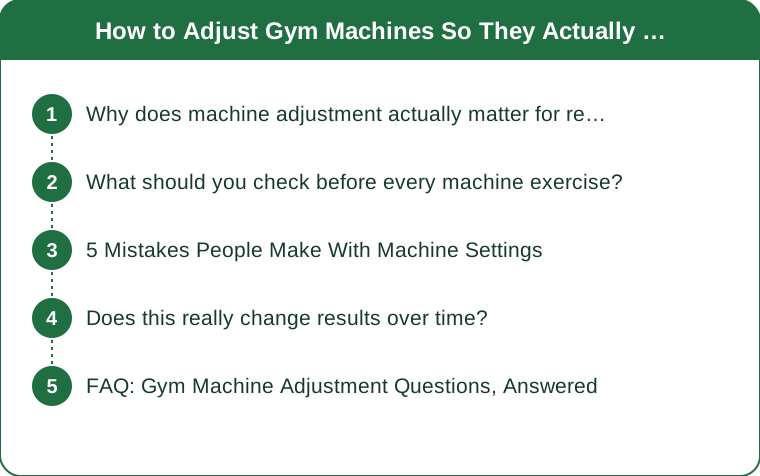
Why does machine adjustment actually matter for results?
Because the seat height, pad position, and range of motion are all calibrated to a specific body position, and even a few inches off can shift the load onto the wrong muscle or joint entirely.
A chest press seat set too low, for example, turns a chest exercise into a shoulder-dominant one — the machine still moves, but the muscle you’re trying to train barely engages.
What should you check before every machine exercise?
Seat height first — for most machines, joints (knee, shoulder, hip depending on the machine) should align with the machine’s pivot point, visible as a small dot or line on the frame.
Then range of motion — start and end positions should let the target muscle move through a full stretch and squeeze without the pads blocking natural movement, which usually means a small backrest or pad tweak beyond just the seat.

5 Mistakes People Make With Machine Settings
1. Never touching the seat at all — using whatever the last person set. 2. Adjusting seat height but ignoring pad depth or backrest angle — these matter just as much for alignment. 3. Setting weight before position — get the position right first, since wrong position changes what “correct” weight even means.
4. Not re-checking after a machine feels off — small discomfort often means the setting is wrong, not that the exercise itself doesn’t suit you. 5. Assuming pin-adjustable machines don’t need positional adjustment — the weight pin is separate from body-fit adjustments.
Does this really change results over time?
Yes, meaningfully — proper alignment ensures the target muscle handles the load instead of joints or connective tissue compensating, which affects both strength gains and injury risk over months of training.
People who consistently misalign machine settings often report plateauing or nagging joint discomfort that resolves once positioning is corrected — a sign the muscle wasn’t actually doing the work.
FAQ: Gym Machine Adjustment Questions, Answered
How do I know what the pivot point marking looks like?
Most machines have a small dot, line, or icon on the frame near the seat rail — align the corresponding joint (shown in a small diagram on many machines) with that mark.
Should I ask staff for help with settings?
Yes, especially early on — most gym staff are glad to do a quick walkthrough of proper machine setup, and it takes just a few minutes to learn the key adjustment points.
Does this matter as much on cardio machines?
Less critically for injury risk, but still worth it — an improperly set incline or stride length on cardio equipment can cause unnecessary joint strain over a long session.
TL;DR:
- Machines are often left at the previous user’s settings, not yours
- Seat height, pad depth, and backrest angle all affect which muscle actually does the work
- Get position right before adjusting weight, not after
- Proper alignment reduces plateaus and unnecessary joint strain over time
Next time you sit down at a machine, take 60 seconds to check the seat before your first rep.
Keep Reading
This article is for general informational and styling purposes only. Fit, sizing, and product availability may vary.